Water, stone & the living veld
A field guide to the wet places, flowers and wildlife in and around Cloudskraal. Follow the water through the farm, then look closer at the different worlds held in clay, sandstone and quartz.
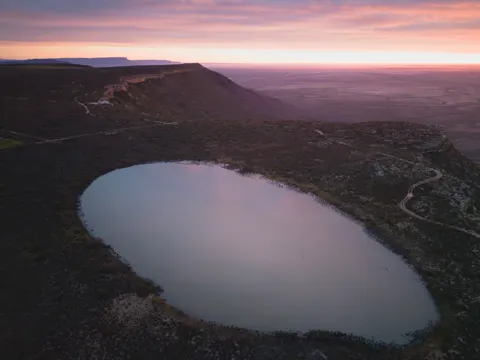
The land that holds water
Some of the most interesting ground is wet for only part of the year. Around Nieuwoudtville, seasonal pans, seeps and wet valley bottoms create habitats that change as the winter rains arrive and the ground dries again.
On the farm, Melkvlei and Groenvlei are named vleilande, with Flaminklvlei at Garsland. The family uses Onderste Dam, Boonste Dam, Garsland Dam and Gaaitjie for swimming through the year. These dams are a different water setting from the surrounding wet ground.
In spring, Alex describes a stream running through Popelierbos towards Nieuwoudtville Waterfall, in the Doring River catchment. The shade of the poplars, a moving stream and the open vleis offer different ways to experience water in this landscape.
Farm places and seasonal water observations from Alex Nel, October 2026. The regional wetland account is described by the Department of Water and Sanitation · Nieuwoudtville wetlands, section 17.5.
Reeds, rushes & small wetland worlds
A feathery common reed is a grass. Papkuil has a dense brown flower spike and belongs to another family. Sedges, true rushes and restios add other forms. Identifying them means looking at the stems, leaves and flower heads, rather than calling every tall wetland plant a reed.
Dense reedbeds can be natural habitat, providing cover for wildlife. Their extent can also change with water, nutrients and disturbance. A photograph alone cannot tell that whole story.
The Bokkeveld’s seasonal pools have their own botanical history, including tiny wetland ferns. A summer-dry pool can still be an important wet place.
The farm’s water places
- Melkvlei
- One of the farm's vleilande, identified by Alex.
- Groenvlei
- A second named vleiland in the farm landscape.
- Flaminklvlei
- The vleiland at Garsland; the place name is retained as supplied by Alex.
- Onderste Dam
- Used by the family for swimming through the year.
- Boonste Dam
- Used by the family for swimming through the year.
- Garsland Dam
- Used by the family for swimming through the year.
- Gaaitjie
- One of the year-round swimming dams named by Alex.
- Popelierbos
- Alex describes a spring stream running through the poplar wood towards Nieuwoudtville Waterfall, in the Doring River catchment.
A different veld, a few steps away
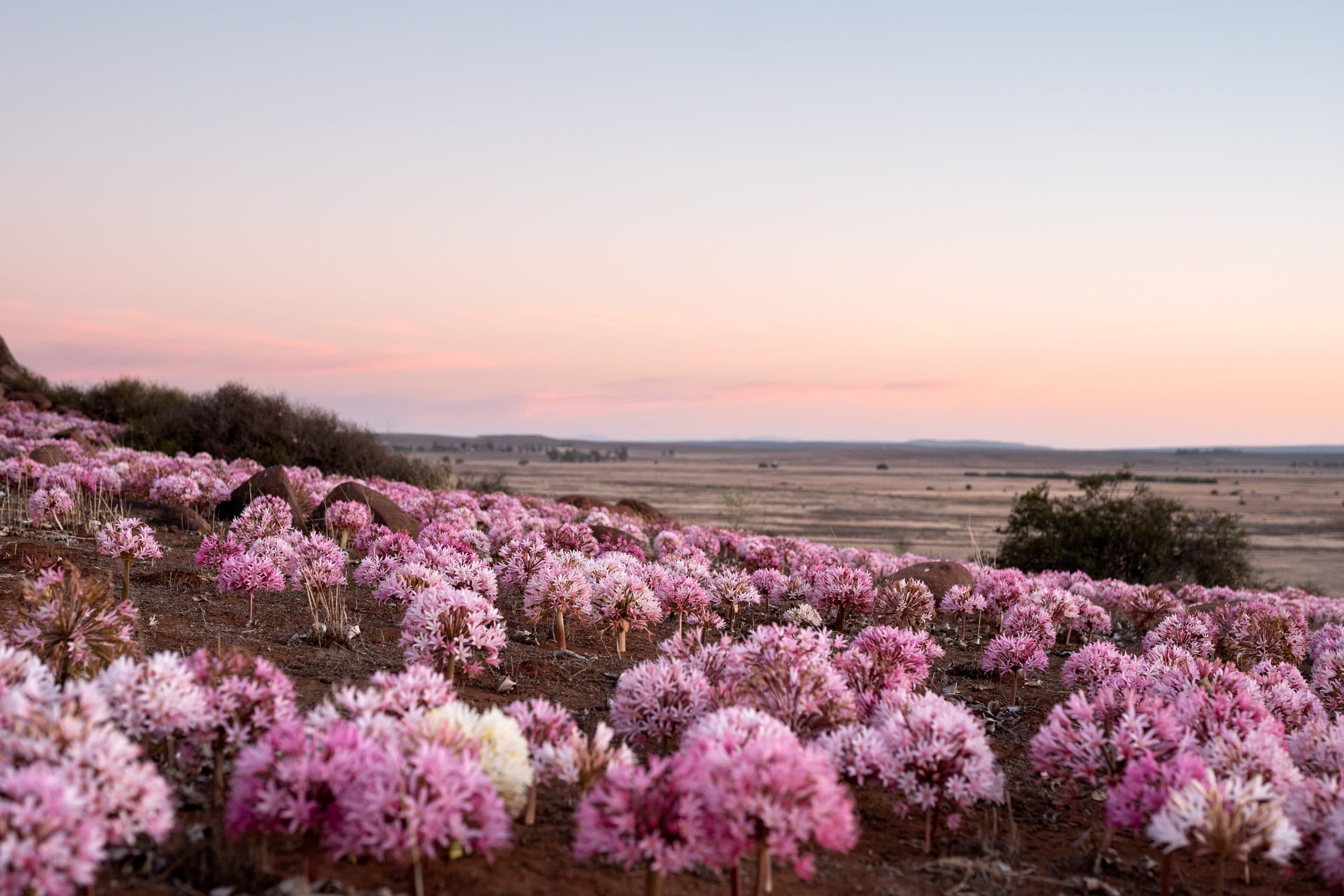
Flower country is a mosaic. The red clays around dolerite koppies, stony tillite ground and sandstone fynbos support different plant communities. A scented arum in a wet rock crevice belongs to a very particular setting; rooibos cultivation and the wild flora beside it have their own stories.
Spring is only one chapter. Alex’s Maartblomme photographs record an autumn display in March 2021. Flowering responds to the season’s conditions, so the dates in this guide are observations and regional windows, rather than promises.
Below the krans: the Knersvlakte
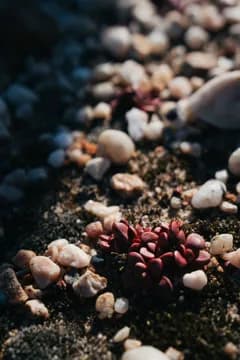
The lower plain’s white quartz patches shelter specialised dwarf succulents. This is a different setting from the plateau above. The guide keeps lower-Knersvlakte records attached to that geography, so a regional plant name is never assigned to a farm photograph simply because quartz appears in the frame.
Some stay. Some return with the season.
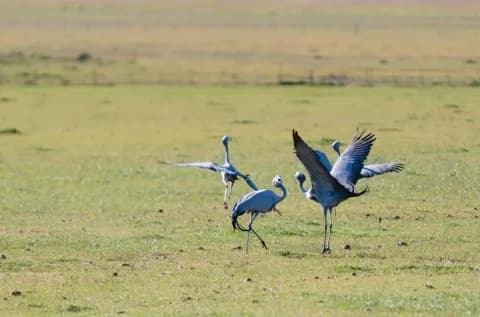
Bird movement has more than one rhythm. Blue cranes move locally and gather in flocks. Lesser kestrels visit southern Africa from the northern hemisphere. Black harriers can travel seasonally within Africa.
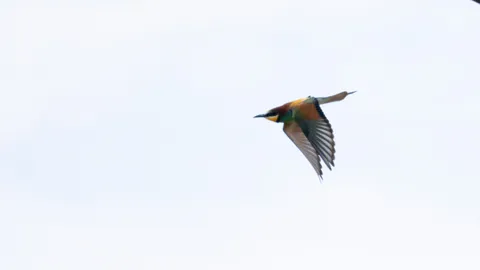
The European bee-eater in Alex’s October 2021 photograph is one of the farm’s recorded visitors. The species includes both long-distance visitors and birds that migrate within Africa; this individual’s journey cannot be read from its photograph.
Barn swallows show another connection between migration and wet places: communal reedbed roosts are documented in southern Africa. A roost has not been recorded on Cloudskraal in this guide.
The species guide
Explore plants, birds and other wildlife by name or habitat. Owner-identified photographs record particular observations. Regional records come from published accounts of the surrounding country; they are not all farm sightings. Some are historical and are labelled in their notes.
Wider-range references give broader context, while identification comparisons help distinguish plants such as reeds and bulrushes. Open an entry for its notes, seasonal context and sources. The guide can grow as dated photographs and checked identifications are added.
Flowering and wildlife activity windows are regional guides and depend on conditions. Unknown seasons do not mean absence, and a regional entry does not establish farm presence.
258 entries
Blue pride of Nieuwoudtville
Geissorhiza splendidissima
Family: Iridaceae · Genus: Geissorhiza
Blou trots
Stony clay renosterveld · Nieuwoudtville
Bloom window: Late August–September
Regional record
Notes & sources
A blue-flowered cormous plant of the Bokkeveld. The regional record is separate from the common-name flower captions in our archive.
Late August–September; rain and temperature affect flowering.
Typical regional flowering window. Month-level or seasonal approximation; rainfall, temperature and locality can change bloom timing. No exact day boundaries inferred.
External identification references; not farm photographs or occurrence records.
- File:Geissorhiza splendidissima 1DS-II 2-2593.jpg
SAplants · CC BY-SA 4.0
provider-labelled exact species; not independently identified
- File:Geissorhiza splendidissima 1DS-II 2-2594.jpg
SAplants · CC BY-SA 4.0
provider-labelled exact species; not independently identified
- File:Geissorhiza splendidissima 1DS-II 2-2593.jpg
Scented arum
Zantedeschia odorata
Family: Araceae · Genus: Zantedeschia
Soetvarkblom
Wet dolerite boulder crevices · Nieuwoudtville
Bloom window: Late July–August
Regional record
Notes & sources
Associated with wet crevices in the local dolerite landscape. Its very particular habitat should not be confused with any damp patch on the farm.
Late winter, around July–August in the cited account.
Typical regional flowering window. Month-level or seasonal approximation; rainfall, temperature and locality can change bloom timing. No exact day boundaries inferred.
- SANBI · Zantedeschia odorata
- SANBI · Hantam geology
- PZA-ARUM
- GBIF accepted genus record: Zantedeschia — family Araceae
External identification references; not farm photographs or occurrence records.
- File:Zantedeschia odorata 26062411.jpg
Chris Vynbos · CC BY-SA 4.0
provider-labelled exact species; not independently identified
- File:Zantedeschia odorata 26062481.jpg
Chris Vynbos · CC BY-SA 4.0
provider-labelled exact species; not independently identified
Rooikatstert
Bulbinella latifolia subsp. doleritica
Family: Asphodelaceae · Genus: Bulbinella
Heavy red dolerite clay · Bokkeveld
Bloom window: Winter–spring display
Regional record
Notes & sources
Yellow flower spikes are characteristic of the region's dolerite veld. Older accounts use the rank var. doleritica.
Winter–spring.
Typical regional flowering window. Month-level or seasonal approximation; rainfall, temperature and locality can change bloom timing. No exact day boundaries inferred.
- SANBI · Bulbinella latifolia subsp. doleritica
- BULB-RL
- GBIF accepted genus record: Bulbinella — family Asphodelaceae
External identification references; not farm photographs or occurrence records.
- File:Bulbinella latifolia doleritica 15515356.jpg
Chris Vynbos · CC BY-SA 4.0
provider label Bulbinella latifolia doleritica; matches subspecies epithet; rank wording normalized from existing inventory
- File:Bulbinella latifolia doleritica 15515358.jpg
Chris Vynbos · CC BY-SA 4.0
provider label Bulbinella latifolia doleritica; matches subspecies epithet; rank wording normalized from existing inventory
Harlequin evening flower
Hesperantha vaginata
Family: Iridaceae · Genus: Hesperantha
Perdeblom
Dolerite clay · Bokkeveld to Calvinia
Bloom window: August–September
Regional record
Notes & sources
A flower connected to specialised monkey-beetle pollination in the regional literature.
August–September.
Typical regional flowering window. Month-level or seasonal approximation; rainfall, temperature and locality can change bloom timing. No exact day boundaries inferred.
External identification references; not farm photographs or occurrence records.
- Hesperantha vaginata — iNaturalist photo 153667567
(c) Karen Eichholz, some rights reserved (CC BY) · CC BY 4.0
provider-labelled exact taxon; not independently identified
- Hesperantha vaginata — iNaturalist photo 153667567
Karoo satin flower
Romulea monadelpha
Family: Iridaceae · Genus: Romulea
Karoosatynblom
Dolerite renosterveld · Nieuwoudtville
Bloom window: Late July–October
Regional record
Notes & sources
One of the geophytes described in SANBI's dolerite-veld guide.
Late July–October in the regional account.
Typical regional flowering window. Month-level or seasonal approximation; rainfall, temperature and locality can change bloom timing. No exact day boundaries inferred.
External identification references; not farm photographs or occurrence records.
- File:Romulea monadelpha 1DS-II 2-2507.jpg
SAplants · CC BY-SA 4.0
provider-labelled exact species; not independently identified
- File:Romulea monadelpha 1DS-II 2-2508.jpg
SAplants · CC BY-SA 4.0
provider-labelled exact species; not independently identified
- File:Romulea monadelpha 1DS-II 2-2507.jpg
Candelabra lily
Brunsvigia bosmaniae
Family: Amaryllidaceae · Genus: Brunsvigia
Maartblom
Open flats and rocky ground · Bokkeveld
Bloom window: Summer–autumn; local autumn display
Regional record
Notes & sources
A regional candidate for learning about autumn-flowering bulbs. Our photographs are owner-captioned Maartblomme; that name alone is not a checked species identification.
Late summer–autumn; local displays depend on conditions.
Typical regional flowering window. Month-level or seasonal approximation; rainfall, temperature and locality can change bloom timing. No exact day boundaries inferred.
External identification references; not farm photographs or occurrence records.
- File:Brunsvigia bosmaniae 20D 4981.jpg
SAplants · CC BY-SA 4.0
provider-labelled exact species; not independently identified
- File:Brunsvigia bosmaniae 20D 4982.jpg
SAplants · CC BY-SA 4.0
provider-labelled exact species; not independently identified
- File:Brunsvigia bosmaniae 20D 4981.jpg
Nieuwoudtville resin bush
Euryops virgatus
Family: Asteraceae · Genus: Euryops
Harpuisbos
Localised Hantam habitat
Bloom window: June–August
Regional record
Notes & sources
A locally restricted shrub in the SANBI account. Included as regional context without a collecting location or farm occurrence claim.
June–August.
Typical regional flowering window. Month-level or seasonal approximation; rainfall, temperature and locality can change bloom timing. No exact day boundaries inferred.
External identification references; not farm photographs or occurrence records.
- Euryops virgatus — iNaturalist photo 96736873
(c) Brian du Preez, some rights reserved (CC BY-SA) · CC BY-SA 4.0
provider-labelled exact taxon; not independently identified
- Euryops virgatus — iNaturalist photo 96736873
Rooibos
Aspalathus linearis
Family: Fabaceae · Genus: Aspalathus
Rooibostee
Cultivated lands · Cloudskraal
Bloom window: Spring–early summer
Owner-identified photograph
Notes & sources
Our cultivated crop is documented in the family's photographs. Flowering was photographed on 21 October 2021; this does not establish a wild rooibos population on the property.
Typical regional flowering window. Month-level or seasonal approximation; rainfall, temperature and locality can change bloom timing. No exact day boundaries inferred.
See the family photograph collection
- SANBI · Aspalathus linearis
- Alex Nel · dated family photograph collection
- ROOIWILD
- GBIF accepted genus record: Aspalathus — family Fabaceae
External identification references; not farm photographs or occurrence records.
- File:Aspalathus linearis 171407970.jpg
Dave Richardson · CC BY 4.0
provider-labelled exact species; not independently identified
Quiver tree
Aloidendron dichotomum
Family: Asphodelaceae · Genus: Aloidendron
Kokerboom
Rocky arid country · wider region
Bloom window: June–July
Wider-range reference
Notes & sources
A wider-region species, rather than a claim about plateau farmland or a tree identified on Cloudskraal.
June–July flowering in the species account.
Typical regional flowering window. Month-level or seasonal approximation; rainfall, temperature and locality can change bloom timing. No exact day boundaries inferred.
External identification references; not farm photographs or occurrence records.
- Aloidendron dichotomum — iNaturalist photo 12403769
(c) Tony Rebelo, some rights reserved (CC BY-SA) · CC BY-SA 4.0
provider-labelled exact taxon; not independently identified
- Aloidendron dichotomum — iNaturalist photo 12403769
Common reed
Phragmites australis
Family: Poaceae · Genus: Phragmites
Fluitjiesriet
Wet ground, river margins and reedbeds
Bloom window: December–June
Identification guide · not recorded on farm
Notes & sources
A tall reed grass with feathery flower heads. Compare it with bulrushes and sedges; the reed species in the farm's wet places still needs to be identified.
Typical regional flowering window. Month-level or seasonal approximation; rainfall, temperature and locality can change bloom timing. No exact day boundaries inferred.
- SANBI · Phragmites australis
- Water Research Commission · WET-Health
- GBIF accepted genus record: Phragmites — family Poaceae
External identification references; not farm photographs or occurrence records.
- Phragmites australis — iNaturalist photo 51626641
(c) Douglas Goldman, some rights reserved (CC BY-SA) · CC BY-SA 4.0
provider-labelled exact taxon; not independently identified
Bulrush
Typha capensis
Family: Typhaceae · Genus: Typha
Papkuil · Matjiesriet
Freshwater margins and muddy wet ground
Bloom window: December–January
Identification guide · not recorded on farm
Notes & sources
The dense brown cylindrical flower head differs from a reed's feathery plume. This is a comparison species, not a recorded farm identification.
Typical regional flowering window. Month-level or seasonal approximation; rainfall, temperature and locality can change bloom timing. No exact day boundaries inferred.
External identification references; not farm photographs or occurrence records.
- File:Interior of a typical Cape tobacco shed, Kleinplasie Open Air Agricultural Museum and Show Grounds, Worcester, South Africa 06.jpg
Roché Petersen · CC BY-SA 3.0
provider-labelled exact species; not independently identified
- File:Interior of a typical Cape tobacco shed, Kleinplasie Open Air Agricultural Museum and Show Grounds, Worcester, South Africa 06.jpg
Ludwig's bustard
Neotis ludwigii
Family: Otididae · Genus: Neotis
Ludwigse pou
Hantam regional bird list
June–October · regional seasonal use
Regional record
Notes & sources
A regional bird to recognise in open country, rather than a farm checklist record.
Ludwig’s Bustard is a large ground bird of open plains and low shrubland. It eats a mixture of small animals and plant material, and males display from open vantage points during courtship. Its brown head and fore-neck, orange hind-neck and white nape help distinguish it from Denham’s Bustard. Birds can travel widely between feeding areas; movements and the need for open habitat make a single regional record a poor predictor of where one will appear next.
Field clue: On open plains, look for the brown head and fore-neck, orange hind-neck and white nape; Denham’s Bustard has a contrasting black crown and white eyebrow.
Some birds use winter-rainfall Succulent Karoo and western Nama Karoo during these months. Partial migration and nomadism mean this is neither an exclusive window nor a farm prediction.
- SANBI · Hantam wildlife and biodiversity
- CapeNature: Knersvlakte Nature Reserve PAMP 2020–2030, taxa pp. 27–33
- iNaturalist: research-grade regional observation 33416731 (community identification)
- BirdLife South Africa: 2025 Red Data Book, Ludwig’s Bustard
- GBIF Backbone Taxonomy — Neotis ludwigii
External identification references; not farm photographs or occurrence records.
- Species photograph reference
(c) linkie, some rights reserved (CC BY) · CC BY 4.0
community_research_grade_not_independently_verified
Long-proboscid fly
Prosoeca marinusi
Family: Nemestrinidae · Genus: Prosoeca
Flower-pollinator habitats · Nieuwoudtville–Hantamsberg
August–November · recorded adult flight
Regional record
Notes & sources
A 2021 study examined this fly feeding from Babiana vanzijliae. The 2025 revision extends the known range towards Hantamsberg; the identity should not be assigned to every flower-visiting fly.
This long-proboscid fly is a specialised member of the Nieuwoudtville flower fauna. Its exceptionally long feeding tube reaches nectar in long-tubed flowers, and documented visits include Lapeirousia, Babiana and Nemesia species. The 2025 taxonomic revision recognises a narrow range around Nieuwoudtville extending toward the Hantamsberg near Calvinia. Its grey to dark body and smoky wings help describe it, but distinguishing related flies requires more than simply seeing a very long proboscis.
Field clue: A long proboscis, grey to dark body and smoky wings are useful clues; photograph the whole fly and flower because other Prosoeca can look similar.
The revision reports adults from early August to early November, slightly later on Hantamsberg. Rounded to calendar months; not every day or an annual guarantee. Other life stages are not covered.
- Karolyi and colleagues · Nectar uptake in Prosoeca
- Theron, Ellis and Midgley · Prosoeca revision, 2025
- Barraclough (2018): Prosoeca marinusi, described from Hantam NBG
- iNaturalist: research-grade regional observation 11007431 (community identification)
- Theron, Ellis & Midgley (2025): ZooKeys 1257, Prosoeca marinusi treatment
- GBIF Backbone Taxonomy — Prosoeca marinusi
- Theron, Ellis & Midgley (2025), ZooKeys 1257: Prosoeca marinusi Biology, p. 264
External identification references; not farm photographs or occurrence records.
- Species photograph reference
(c) desertnaturalist, some rights reserved (CC BY) · CC BY 4.0
community_research_grade_not_independently_verified
Bokkeveld pillwort
Pilularia bokkeveldensis
Family: Marsileaceae · Genus: Pilularia
Seasonal-pan edges · Bokkeveld sandstone fynbos
Non-flowering plant
Regional record
Notes & sources
An unusual wetland fern. SANBI's 2013 assessment refers to a 2001 collection; this is a historical regional record and present occurrence needs checking.
Wet-season habitat; a fern has no flowering season.
A fern does not have a flowering season.
Burchell's water-clover
Marsilea burchellii
Family: Marsileaceae · Genus: Marsilea
Seasonal pans · Nieuwoudtville and Hantamsberg vouchers
Non-flowering plant
Regional record
Notes & sources
A water fern represented by historical herbarium specimens. The records are useful context for seasonal pools, not a current farm identification.
A fern does not have a flowering season.
Water star
Pauridia aquatica
Family: Hypoxidaceae · Genus: Pauridia
Seasonal pools and vlei edges · broad Cape range
Bloom window: May–November
Identification guide · not recorded on farm
Notes & sources
A winter-growing geophyte, called Spiloxene aquatica in older sources. Included as a wetland comparison; a Cloudskraal occurrence is unverified.
May–November across the species account's wider range.
Typical regional flowering window. Month-level or seasonal approximation; rainfall, temperature and locality can change bloom timing. No exact day boundaries inferred.
External identification references; not farm photographs or occurrence records.
- File:Pauridia aquatica 1DS-II 2-2670.jpg
SAplants · CC BY-SA 4.0
provider-labelled exact species; not independently identified
- File:Pauridia aquatica 1DS-II 2-2670.jpg
Button plant
Conophytum calculus subsp. calculus
Family: Aizoaceae · Genus: Conophytum
Knopies
Quartz patches · lower Knersvlakte
Bloom window: Autumn
Regional record
Notes & sources
A dwarf succulent of the lower plain's quartz habitats. The unidentified plants in our quartz photograph are not assigned this name.
Autumn, with night-opening flowers in the species account.
Typical regional flowering window. Month-level or seasonal approximation; rainfall, temperature and locality can change bloom timing. No exact day boundaries inferred.
- SANBI · Conophytum calculus subsp. calculus
- GBIF accepted genus record: Conophytum — family Aizoaceae
External identification references; not farm photographs or occurrence records.
- Conophytum calculus calculus — iNaturalist photo 33479182
(c) Brian du Preez, some rights reserved (CC BY-SA) · CC BY-SA 4.0
provider-labelled exact taxon; not independently identified
Lapeirousia oreogena
Lapeirousia oreogena
Family: Iridaceae · Genus: Lapeirousia
Dolerite clay; also stony tillite · Nieuwoudtville–Calvinia district
Bloom window: August–mid September
Regional record
Notes & sources
Regional guide candidate; occurrence on Cloudskraal has not been confirmed.
Typical regional flowering window. Month-level or seasonal approximation; rainfall, temperature and locality can change bloom timing. No exact day boundaries inferred.
External identification references; not farm photographs or occurrence records.
- File:Lapeirousia oreogena 15514499.jpg
Chris Vynbos · CC BY-SA 4.0
provider-labelled exact species; not independently identified
- File:Lapeirousia oreogena 15514504.jpg
Chris Vynbos · CC BY-SA 4.0
provider-labelled exact species; not independently identified
- File:Lapeirousia oreogena 15514499.jpg
Gladiolus scullyi
Gladiolus scullyi
Family: Iridaceae · Genus: Gladiolus
Dolerite renosterveld · Nieuwoudtville dolerite veld
Bloom window: Winter–spring display
Regional record
Notes & sources
Regional guide candidate; occurrence on Cloudskraal has not been confirmed.
Typical regional flowering window. Month-level or seasonal approximation; rainfall, temperature and locality can change bloom timing. No exact day boundaries inferred.
External identification references; not farm photographs or occurrence records.
- File:Gladiolus scullyi 1DS-II 2-2598.jpg
SAplants · CC BY-SA 4.0
provider-labelled exact species; not independently identified
- File:Gladiolus scullyi 1DS-II 2-2598.png
SAplants · CC BY-SA 4.0
provider-labelled exact species; not independently identified
- File:Gladiolus scullyi 1DS-II 2-2598.jpg
Joyce Lewis’s diascia / horinkies
Diascia lewisiae
Family: Scrophulariaceae · Genus: Diascia
Sandy loam to clay loam; renosterveld margins · Grasberg and Hantam
Bloom window: August–September, rainfall dependent
Regional record
Notes & sources
Regional guide candidate; occurrence on Cloudskraal has not been confirmed.
Typical regional flowering window. Month-level or seasonal approximation; rainfall, temperature and locality can change bloom timing. No exact day boundaries inferred.
Arctotis acaulis
Arctotis acaulis
Family: Asteraceae · Genus: Arctotis
Flats and lower slopes; varied soils · Nieuwoudtville–Calvinia and wider Cape
Bloom window: Spring–early summer
Regional record
Notes & sources
Regional guide candidate; occurrence on Cloudskraal has not been confirmed.
Typical regional flowering window. Month-level or seasonal approximation; rainfall, temperature and locality can change bloom timing. No exact day boundaries inferred.
External identification references; not farm photographs or occurrence records.
- File:Arctotis acaulis 5Dsr 0899-01.jpg
SAplants · CC BY-SA 4.0
provider-labelled exact species; not independently identified
- File:Arctotis acaulis 5Dsr 0899-02.jpg
SAplants · CC BY-SA 4.0
provider-labelled exact species; not independently identified
- File:Arctotis acaulis 5Dsr 0899-01.jpg
Cotula nudicaulis
Cotula nudicaulis
Family: Asteraceae · Genus: Cotula
Regional spring-flower display; soil unspecified · Hantam
Bloom window: Spring display
Regional record
Notes & sources
Regional guide candidate; occurrence on Cloudskraal has not been confirmed.
Typical regional flowering window. Month-level or seasonal approximation; rainfall, temperature and locality can change bloom timing. No exact day boundaries inferred.
External identification references; not farm photographs or occurrence records.
- File:Cotula nudicaulis 1DS-II 2-2492.jpg
SAplants · CC BY-SA 4.0
provider-labelled exact species; not independently identified
- File:Cotula nudicaulis 1DS-II 2-2493.jpg
SAplants · CC BY-SA 4.0
provider-labelled exact species; not independently identified
- File:Cotula nudicaulis 1DS-II 2-2492.jpg
Nemesia cheiranthus
Nemesia cheiranthus
Family: Scrophulariaceae · Genus: Nemesia
Regional spring-flower display; soil unspecified · Hantam
Bloom window: Spring display
Regional record
Notes & sources
Regional guide candidate; occurrence on Cloudskraal has not been confirmed.
Typical regional flowering window. Month-level or seasonal approximation; rainfall, temperature and locality can change bloom timing. No exact day boundaries inferred.
External identification references; not farm photographs or occurrence records.
- File:Nemesia cheiranthus 1DS-II 2-2483.jpg
SAplants · CC BY-SA 4.0
provider-labelled exact species; not independently identified
- File:Nemesia cheiranthus 1DS-II 2-2486.jpg
SAplants · CC BY-SA 4.0
provider-labelled exact species; not independently identified
- File:Nemesia cheiranthus 1DS-II 2-2483.jpg
Senecio cakilefolius
Senecio cakilefolius
Family: Asteraceae · Genus: Senecio
Regional spring-flower display; soil unspecified · Hantam
Bloom window: Spring display
Regional record
Notes & sources
Regional guide candidate; occurrence on Cloudskraal has not been confirmed.
Typical regional flowering window. Month-level or seasonal approximation; rainfall, temperature and locality can change bloom timing. No exact day boundaries inferred.
Red cup-and-saucer
Colchicum coloratum
Family: Colchicaceae · Genus: Colchicum
Red clay in dolerite koppies · Hantam dolerite veld
Bloom window: July–mid September
Regional record
Notes & sources
Regional guide candidate; occurrence on Cloudskraal has not been confirmed.
Typical regional flowering window. Month-level or seasonal approximation; rainfall, temperature and locality can change bloom timing. No exact day boundaries inferred.
External identification references; not farm photographs or occurrence records.
- Colchicum burchellii pulchrum — iNaturalist photo 94339248
(c) Tony Rebelo, some rights reserved (CC BY-SA) · CC BY-SA 4.0
provider-labelled Colchicum burchellii pulchrum; exact accepted subspecies linked by Kew synonymy to inventory Colchicum coloratum; not independently identified
- Colchicum burchellii pulchrum — iNaturalist photo 94339248
Gansogies / knoppiesopslag
Cotula barbata
Family: Asteraceae · Genus: Cotula
Mostly sandy flats; sometimes stony clay · Bokkeveld escarpment and wider region
Bloom window: July–October
Wider-range reference
Notes & sources
Regional guide candidate; occurrence on Cloudskraal has not been confirmed.
Typical regional flowering window. Month-level or seasonal approximation; rainfall, temperature and locality can change bloom timing. No exact day boundaries inferred.
External identification references; not farm photographs or occurrence records.
- Cotula barbata — iNaturalist photo 24595936
(c) Tony Rebelo, some rights reserved (CC BY-SA) · CC BY-SA 4.0
provider-labelled exact taxon; not independently identified
- Cotula barbata — iNaturalist photo 24595936
Blue tulp / blou-uintjie
Moraea tripetala
Family: Iridaceae · Genus: Moraea
Sand and clay · Broad western Cape / western Karoo range
Bloom window: August–December across broad range
Wider-range reference
Notes & sources
Regional guide candidate; occurrence on Cloudskraal has not been confirmed.
Typical regional flowering window. Month-level or seasonal approximation; rainfall, temperature and locality can change bloom timing. No exact day boundaries inferred.
External identification references; not farm photographs or occurrence records.
- Moraea tripetala — iNaturalist photo 151419295
no rights reserved · CC0 1.0
provider-labelled exact taxon; not independently identified
- Moraea tripetala — iNaturalist photo 151419295
Ixia rapunculoides
Ixia rapunculoides
Family: Iridaceae · Genus: Ixia
Hantam
Bloom window: Spring
Regional record
Notes & sources
Regional guide candidate; occurrence on Cloudskraal has not been confirmed.
Typical regional flowering window. Month-level or seasonal approximation; rainfall, temperature and locality can change bloom timing. No exact day boundaries inferred.
External identification references; not farm photographs or occurrence records.
- Ixia rapunculoides — iNaturalist photo 94339141
(c) Tony Rebelo, some rights reserved (CC BY-SA) · CC BY-SA 4.0
provider-labelled exact taxon; not independently identified
- Ixia rapunculoides — iNaturalist photo 94339141
Crossyne flava
Crossyne flava
Family: Amaryllidaceae · Genus: Crossyne
Hantam
Bloom window: Autumn
Regional record
Notes & sources
Regional guide candidate; occurrence on Cloudskraal has not been confirmed.
Typical regional flowering window. Month-level or seasonal approximation; rainfall, temperature and locality can change bloom timing. No exact day boundaries inferred.
External identification references; not farm photographs or occurrence records.
- Crossyne flava — iNaturalist photo 116162377
(c) Danwill Beukes, some rights reserved (CC BY-SA) · CC BY-SA 4.0
provider-labelled exact taxon; not independently identified
- Crossyne flava — iNaturalist photo 116162377
Boophone haemanthoides
Boophone haemanthoides
Family: Amaryllidaceae · Genus: Boophone
Rocky dolerite · Hantam
Bloom window: Autumn
Regional record
Notes & sources
Regional guide candidate; occurrence on Cloudskraal has not been confirmed.
Typical regional flowering window. Month-level or seasonal approximation; rainfall, temperature and locality can change bloom timing. No exact day boundaries inferred.
External identification references; not farm photographs or occurrence records.
- Boophone haemanthoides — iNaturalist photo 51392321
(c) Brian du Preez, some rights reserved (CC BY-SA) · CC BY-SA 4.0
provider-labelled exact taxon; not independently identified
- Boophone haemanthoides — iNaturalist photo 51392321
Haemanthus amarylloides
Haemanthus amarylloides
Family: Amaryllidaceae · Genus: Haemanthus
Hantam
Bloom window: Autumn
Regional record
Notes & sources
Regional guide candidate; occurrence on Cloudskraal has not been confirmed.
Typical regional flowering window. Month-level or seasonal approximation; rainfall, temperature and locality can change bloom timing. No exact day boundaries inferred.
External identification references; not farm photographs or occurrence records.
- Haemanthus amarylloides — iNaturalist photo 324173094
(c) Tony Rebelo, some rights reserved (CC BY-SA) · CC BY-SA 4.0
provider-labelled exact taxon; not independently identified
- Haemanthus amarylloides — iNaturalist photo 324173094
Haemanthus coccineus
Haemanthus coccineus
Family: Amaryllidaceae · Genus: Haemanthus
Hantam
Bloom window: Autumn
Regional record
Notes & sources
Regional guide candidate; occurrence on Cloudskraal has not been confirmed.
Typical regional flowering window. Month-level or seasonal approximation; rainfall, temperature and locality can change bloom timing. No exact day boundaries inferred.
External identification references; not farm photographs or occurrence records.
- Haemanthus coccineus — iNaturalist photo 32466423
(c) magriet b, some rights reserved (CC BY-SA) · CC BY-SA 4.0
provider-labelled exact taxon; not independently identified
- Haemanthus coccineus — iNaturalist photo 32466423
Veltheimia capensis
Veltheimia capensis
Family: Asparagaceae · Genus: Veltheimia
Hantam
Bloom window: May–July
Regional record
Notes & sources
Regional guide candidate; occurrence on Cloudskraal has not been confirmed.
Typical regional flowering window. Month-level or seasonal approximation; rainfall, temperature and locality can change bloom timing. No exact day boundaries inferred.
External identification references; not farm photographs or occurrence records.
- Veltheimia capensis — iNaturalist photo 568476996
no rights reserved · CC0 1.0
provider-labelled exact taxon; not independently identified
- Veltheimia capensis — iNaturalist photo 568476996
Lachenalia maughanii
Lachenalia maughanii
Family: Asparagaceae · Genus: Lachenalia
Hantam
Bloom window: April–June
Regional record
Notes & sources
Regional guide candidate; occurrence on Cloudskraal has not been confirmed.
Typical regional flowering window. Month-level or seasonal approximation; rainfall, temperature and locality can change bloom timing. No exact day boundaries inferred.
External identification references; not farm photographs or occurrence records.
- File:Lachenalia maughanii00.jpg
Hendrik van Zijl · CC BY-SA 3.0
provider-labelled exact taxon; not independently identified
- File:Lachenalia maughanii00.jpg
Daubenya capensis
Daubenya capensis
Family: Asparagaceae · Genus: Daubenya
Hantam
Bloom window: May–June
Regional record
Notes & sources
Regional guide candidate; occurrence on Cloudskraal has not been confirmed.
Typical regional flowering window. Month-level or seasonal approximation; rainfall, temperature and locality can change bloom timing. No exact day boundaries inferred.
External identification references; not farm photographs or occurrence records.
- Daubenya capensis — iNaturalist photo 435962778
(c) Morten Ross, some rights reserved (CC BY) · CC BY 4.0
provider-labelled exact taxon; not independently identified
- Daubenya capensis — iNaturalist photo 435962778
Massonia depressa
Massonia depressa
Family: Asparagaceae · Genus: Massonia
Hantam
Bloom window: May–July
Regional record
Notes & sources
Regional guide candidate; occurrence on Cloudskraal has not been confirmed.
Typical regional flowering window. Month-level or seasonal approximation; rainfall, temperature and locality can change bloom timing. No exact day boundaries inferred.
External identification references; not farm photographs or occurrence records.
- Massonia depressa — iNaturalist photo 156038158
(c) Nicola van Berkel, some rights reserved (CC BY-SA) · CC BY-SA 4.0
provider-labelled exact taxon; not independently identified
- Massonia depressa — iNaturalist photo 156038158
Daubenya stylosa
Daubenya stylosa
Family: Asparagaceae · Genus: Daubenya
Hantam
Bloom window: May–June
Regional record
Notes & sources
Regional guide candidate; occurrence on Cloudskraal has not been confirmed.
Typical regional flowering window. Month-level or seasonal approximation; rainfall, temperature and locality can change bloom timing. No exact day boundaries inferred.
External identification references; not farm photographs or occurrence records.
- Daubenya stylosa — iNaturalist photo 43132800
(c) Brian du Preez, some rights reserved (CC BY-SA) · CC BY-SA 4.0
provider-labelled exact taxon; not independently identified
- Daubenya stylosa — iNaturalist photo 43132800
Babiana praemorsa
Babiana praemorsa
Family: Iridaceae · Genus: Babiana
Hantam
Bloom window: July–August
Regional record
Notes & sources
Regional guide candidate; occurrence on Cloudskraal has not been confirmed.
Typical regional flowering window. Month-level or seasonal approximation; rainfall, temperature and locality can change bloom timing. No exact day boundaries inferred.
External identification references; not farm photographs or occurrence records.
- Babiana praemorsa — iNaturalist photo 96584041
(c) James Deacon, some rights reserved (CC BY-SA) · CC BY-SA 4.0
provider-labelled exact taxon; not independently identified
- Babiana praemorsa — iNaturalist photo 96584041
Disperis purpurata
Disperis purpurata
Family: Orchidaceae · Genus: Disperis
Clay/granite · Calvinia–Nieuwoudtville
Bloom window: August–October
Wider-range reference
Notes & sources
Regional guide candidate; occurrence on Cloudskraal has not been confirmed.
Typical regional flowering window. Month-level or seasonal approximation; rainfall, temperature and locality can change bloom timing. No exact day boundaries inferred.
External identification references; not farm photographs or occurrence records.
- Disperis purpurata — iNaturalist photo 618437618
(c) Justin Ponder, some rights reserved (CC BY) · CC BY 4.0
provider-labelled descendant subspecies within requested species; no farm subspecies assignment
- Disperis purpurata — iNaturalist photo 618437618
Holothrix aspera
Holothrix aspera
Family: Orchidaceae · Genus: Holothrix
Sand/rock · Springbok–Roggeveld–Swellendam
Bloom window: June–October
Wider-range reference
Notes & sources
Regional guide candidate; occurrence on Cloudskraal has not been confirmed.
Typical regional flowering window. Month-level or seasonal approximation; rainfall, temperature and locality can change bloom timing. No exact day boundaries inferred.
External identification references; not farm photographs or occurrence records.
- Holothrix aspera — iNaturalist photo 422018003
(c) Christina, some rights reserved (CC BY) · CC BY 4.0
provider-labelled exact taxon; not independently identified
- Holothrix aspera — iNaturalist photo 422018003
Holothrix secunda
Holothrix secunda
Family: Orchidaceae · Genus: Holothrix
Rock · Western Northern Cape
Bloom window: June–October
Wider-range reference
Notes & sources
Regional guide candidate; occurrence on Cloudskraal has not been confirmed.
Typical regional flowering window. Month-level or seasonal approximation; rainfall, temperature and locality can change bloom timing. No exact day boundaries inferred.
External identification references; not farm photographs or occurrence records.
- Holothrix secunda — iNaturalist photo 23275687
(c) Kevin Murray, some rights reserved (CC BY) · CC BY 4.0
provider-labelled exact taxon; not independently identified
- Holothrix secunda — iNaturalist photo 23275687
Wollie
Holothrix villosa
Family: Orchidaceae · Genus: Holothrix
Rocky slopes · Bokkeveld–Roggeveld
Bloom window: October–December
Wider-range reference
Notes & sources
Regional guide candidate; occurrence on Cloudskraal has not been confirmed.
Typical regional flowering window. Month-level or seasonal approximation; rainfall, temperature and locality can change bloom timing. No exact day boundaries inferred.
External identification references; not farm photographs or occurrence records.
- Holothrix villosa villosa — iNaturalist photo 157922565
(c) Jeremy Gilmore, some rights reserved (CC BY) · CC BY 4.0
provider-labelled exact taxon; not independently identified; descendant subspecies retained as a species-level reference only
- Holothrix villosa villosa — iNaturalist photo 157922565
Pterygodium crispum
Pterygodium crispum
Family: Orchidaceae · Genus: Pterygodium
Sand · Knersvlakte–Roggeveld
Bloom window: September–October
Wider-range reference
Notes & sources
Regional guide candidate; occurrence on Cloudskraal has not been confirmed.
Typical regional flowering window. Month-level or seasonal approximation; rainfall, temperature and locality can change bloom timing. No exact day boundaries inferred.
- SANBI Extra Cape flora 2013 pp.126–128
- Kew POWO alternative accepted combination
- GBIF accepted genus record: Pterygodium — family Orchidaceae
External identification references; not farm photographs or occurrence records.
- Pterygodium crispum — iNaturalist photo 15132349
(c) Tony Rebelo, some rights reserved (CC BY-SA) · CC BY-SA 4.0
provider-labelled exact taxon; not independently identified
Pterygodium deflexum
Pterygodium deflexum
Family: Orchidaceae · Genus: Pterygodium
Dry scrub · Hantamsberg–Roggeveld
Bloom window: October
Wider-range reference
Notes & sources
Regional guide candidate; occurrence on Cloudskraal has not been confirmed.
Typical regional flowering window. Month-level or seasonal approximation; rainfall, temperature and locality can change bloom timing. No exact day boundaries inferred.
External identification references; not farm photographs or occurrence records.
- Pterygodium deflexum — iNaturalist photo 444772451
(c) Justin Ponder, some rights reserved (CC BY) · CC BY 4.0
provider-labelled exact taxon; not independently identified
- Pterygodium deflexum — iNaturalist photo 444772451
Pterygodium pentherianum
Pterygodium pentherianum
Family: Orchidaceae · Genus: Pterygodium
Clay · Matsikammaberg–Klein Roggeveld
Bloom window: August–September
Wider-range reference
Notes & sources
Regional guide candidate; occurrence on Cloudskraal has not been confirmed.
Typical regional flowering window. Month-level or seasonal approximation; rainfall, temperature and locality can change bloom timing. No exact day boundaries inferred.
External identification references; not farm photographs or occurrence records.
- Pterygodium pentherianum — iNaturalist photo 631329323
(c) Tony Rebelo, some rights reserved (CC BY-SA) · CC BY-SA 4.0
provider-labelled exact taxon; not independently identified
- Pterygodium pentherianum — iNaturalist photo 631329323
Aasblom
Satyrium pumilum
Family: Orchidaceae · Genus: Satyrium
Damp ground · Bokkeveld Plateau
Bloom window: September–December
Wider-range reference
Notes & sources
Regional guide candidate; occurrence on Cloudskraal has not been confirmed.
Typical regional flowering window. Month-level or seasonal approximation; rainfall, temperature and locality can change bloom timing. No exact day boundaries inferred.
External identification references; not farm photographs or occurrence records.
- File:Satyrium pumilum 160403.jpg
Bernd Haynold · CC BY 2.5
provider-labelled exact species; not independently identified
- File:Satyrium pumilum 160403.jpg
Ewwa trewwa
Satyrium erectum
Family: Orchidaceae · Genus: Satyrium
Dry flats · Nieuwoudtville
Bloom window: July–October
Wider-range reference
Notes & sources
Regional guide candidate; occurrence on Cloudskraal has not been confirmed.
Typical regional flowering window. Month-level or seasonal approximation; rainfall, temperature and locality can change bloom timing. No exact day boundaries inferred.
External identification references; not farm photographs or occurrence records.
- File:Satyrium erectum 1DS-II 2-2305.jpg
SAplants · CC BY-SA 4.0
provider-labelled exact species; not independently identified
- File:Satyrium erectum 1DS-II 2-2305.jpg
Satyrium ligulatum
Satyrium ligulatum
Family: Orchidaceae · Genus: Satyrium
Scrub · Nieuwoudtville
Bloom window: September–December
Wider-range reference
Notes & sources
Regional guide candidate; occurrence on Cloudskraal has not been confirmed.
Typical regional flowering window. Month-level or seasonal approximation; rainfall, temperature and locality can change bloom timing. No exact day boundaries inferred.
External identification references; not farm photographs or occurrence records.
- Satyrium ligulatum — iNaturalist photo 105505963
(c) Nicola van Berkel, some rights reserved (CC BY-SA) · CC BY-SA 4.0
provider-labelled exact species; not independently identified
- Satyrium ligulatum — iNaturalist photo 105505963
Satyrium pulchrum
Satyrium pulchrum
Family: Orchidaceae · Genus: Satyrium
Knersvlakte
Bloom window: August–September
Wider-range reference
Notes & sources
Regional guide candidate; occurrence on Cloudskraal has not been confirmed.
Typical regional flowering window. Month-level or seasonal approximation; rainfall, temperature and locality can change bloom timing. No exact day boundaries inferred.
Oupa-met-sy-pyp
Disa spathulata
Family: Orchidaceae · Genus: Disa
Sandstone/shale · Nieuwoudtville
Bloom window: September–October
Regional record
Notes & sources
Regional guide candidate; occurrence on Cloudskraal has not been confirmed.
Typical regional flowering window. Month-level or seasonal approximation; rainfall, temperature and locality can change bloom timing. No exact day boundaries inferred.
- SANBI BODATSA, 1995/1996 vouchers
- SANBI Extra Cape flora
- GBIF accepted genus record: Disa — family Orchidaceae
External identification references; not farm photographs or occurrence records.
- File:Disa spathulata spathulata 319570756.jpg
Dave U · CC BY 4.0
provider-labelled subspecies within requested species; no farm subspecies assignment
Argyroderma theartii
Argyroderma theartii
Family: Aizoaceae · Genus: Argyroderma
Quartz gravel · Northern Knersvlakte
Bloom window: Winter
Wider-range reference
Notes & sources
Regional guide candidate; occurrence on Cloudskraal has not been confirmed.
Typical regional flowering window. Month-level or seasonal approximation; rainfall, temperature and locality can change bloom timing. No exact day boundaries inferred.
Oxalis melanosticta
Oxalis melanosticta
Family: Oxalidaceae · Genus: Oxalis
Clay / tillite · Nieuwoudtville
Bloom window: May–August
Regional record
Notes & sources
Regional guide candidate; occurrence on Cloudskraal has not been confirmed.
Typical regional flowering window. Month-level or seasonal approximation; rainfall, temperature and locality can change bloom timing. No exact day boundaries inferred.
External identification references; not farm photographs or occurrence records.
- Oxalis melanosticta melanosticta — iNaturalist photo 550285901
(c) Brian du Preez, some rights reserved (CC BY-SA) · CC BY-SA 4.0
provider-labelled exact taxon; not independently identified; descendant subspecies retained as a species-level reference only
- Oxalis melanosticta melanosticta — iNaturalist photo 550285901
Pink Afrikander / pienkafrikaner
Gladiolus caryophyllaceus
Family: Iridaceae · Genus: Gladiolus
Sandstone hills and mountain slopes near Nieuwoudtville · Nieuwoudtville / Bokkeveld Escarpment; wider Cape
Bloom window: Late August–late October
Wider-range reference
Notes & sources
Regional guide candidate; occurrence on Cloudskraal has not been confirmed.
Typical regional flowering window. Month-level or seasonal approximation; rainfall, temperature and locality can change bloom timing. No exact day boundaries inferred.
- SANBI PlantZAfrica distribution, habitat and flowering
- GBIF accepted genus record: Gladiolus — family Iridaceae
External identification references; not farm photographs or occurrence records.
- Gladiolus caryophyllaceus — iNaturalist photo 131280298
(c) Tom Lloyd Evans, some rights reserved (CC BY-SA) · CC BY-SA 4.0
provider-labelled exact taxon; not independently identified
Moraea bifida
Moraea bifida
Family: Iridaceae · Genus: Moraea
Renosterveld; light clay and sandy ground · Bokkeveld Plateau / Nieuwoudtville; wider western interior
Bloom window: August–September
Regional record
Notes & sources
Regional guide candidate; occurrence on Cloudskraal has not been confirmed.
Typical regional flowering window. Month-level or seasonal approximation; rainfall, temperature and locality can change bloom timing. No exact day boundaries inferred.
- SANBI BODATSA incorporating Iridaceae of southern Africa 2020
- GBIF accepted genus record: Moraea — family Iridaceae
External identification references; not farm photographs or occurrence records.
- Moraea bifida — iNaturalist photo 153667123
(c) Karen Eichholz, some rights reserved (CC BY) · CC BY 4.0
provider-labelled exact taxon; not independently identified
Moraea pseudospicata
Moraea pseudospicata
Family: Iridaceae · Genus: Moraea
Nieuwoudtville Wildflower Reserve and southern Bokkeveld
Bloom window: Late summer–autumn
Regional record
Notes & sources
Regional guide candidate; occurrence on Cloudskraal has not been confirmed.
Typical regional flowering window. Month-level or seasonal approximation; rainfall, temperature and locality can change bloom timing. No exact day boundaries inferred.
Horinkies
Diascia insignis
Family: Scrophulariaceae · Genus: Diascia
Tillite soils in renosterveld, beneath or between shrubs · Nieuwoudtville / Hantam / southern Bokkeveld
Bloom window: August–September; rainfall dependent
Regional record
Notes & sources
Regional guide candidate; occurrence on Cloudskraal has not been confirmed.
Typical regional flowering window. Month-level or seasonal approximation; rainfall, temperature and locality can change bloom timing. No exact day boundaries inferred.
Pelargonium connivens
Pelargonium connivens
Family: Geraniaceae · Genus: Pelargonium
Nieuwoudtville area
Bloom window: December–January
Regional record
Notes & sources
Regional guide candidate; occurrence on Cloudskraal has not been confirmed.
Typical regional flowering window. Month-level or seasonal approximation; rainfall, temperature and locality can change bloom timing. No exact day boundaries inferred.
Nieuwoudtville conebush
Leucadendron remotum
Family: Proteaceae · Genus: Leucadendron
Bokkeveld Escarpment south of Nieuwoudtville
Bloom window: August–September
Wider-range reference
Notes & sources
Regional guide candidate; occurrence on Cloudskraal has not been confirmed.
Typical regional flowering window. Month-level or seasonal approximation; rainfall, temperature and locality can change bloom timing. No exact day boundaries inferred.
- SANBI Red List regional range, common name and family
- Protea Atlas primary phenology account
- Kew POWO accepted taxon and Proteaceae classification
- GBIF accepted genus record: Leucadendron — family Proteaceae
External identification references; not farm photographs or occurrence records.
- Leucadendron remotum — iNaturalist photo 24544284
(c) Tony Rebelo, some rights reserved (CC BY-SA) · CC BY-SA 4.0
provider-labelled exact taxon; not independently identified
Monilaria chrysoleuca
Monilaria chrysoleuca
Family: Aizoaceae · Genus: Monilaria
Sunny quartz flats with clay soil · Knersvlakte to Namaqualand
Bloom window: May–August
Wider-range reference
Notes & sources
Regional guide candidate; occurrence on Cloudskraal has not been confirmed.
Typical regional flowering window. Month-level or seasonal approximation; rainfall, temperature and locality can change bloom timing. No exact day boundaries inferred.
- SANBI PlantZAfrica: range, habitat and seasonal account
- GBIF accepted genus Monilaria — family Aizoaceae
External identification references; not farm photographs or occurrence records.
- Monilaria chrysoleuca — iNaturalist photo 185335963
(c) leandra-k_89, some rights reserved (CC BY-SA) · CC BY-SA 4.0
provider-labelled exact taxon; not independently identified
Crossvygie / kruisvygie / granietvygie
Ottosonderia monticola
Family: Aizoaceae · Genus: Ottosonderia
Granite hills and rocky mountain terrain · Northern Knersvlakte / Namaqualand
Bloom window: Winter
Wider-range reference
Notes & sources
Regional guide candidate; occurrence on Cloudskraal has not been confirmed.
Typical regional flowering window. Month-level or seasonal approximation; rainfall, temperature and locality can change bloom timing. No exact day boundaries inferred.
Dune tea bush / geelblommetjietee / duinetee
Leysera gnaphalodes
Family: Asteraceae · Genus: Leysera
Dry sandy flats and slopes, including disturbed ground · Knersvlakte / Namaqualand
Bloom window: Mainly September–November; sometimes other months
Wider-range reference
Notes & sources
Regional guide candidate; occurrence on Cloudskraal has not been confirmed.
Typical regional flowering window. Month-level or seasonal approximation; rainfall, temperature and locality can change bloom timing. No exact day boundaries inferred.
- SANBI PlantZAfrica: range, habitat and seasonal account
- GBIF accepted genus Leysera — family Asteraceae
External identification references; not farm photographs or occurrence records.
- Leysera gnaphalodes — iNaturalist photo 120288247
(c) Antoinette Eyssell Knox, some rights reserved (CC BY-SA) · CC BY-SA 4.0
provider-labelled exact taxon; not independently identified
Bokbaaivygie / Livingstone daisy
Cleretum bellidiforme
Family: Aizoaceae · Genus: Cleretum
Open sandy flats, gravelly clay slopes and rocky soils · Bokkeveld / Vanrhynsdorp / Calvinia
Bloom window: August–mid October; usually peaks in September
Wider-range reference
Notes & sources
Regional guide candidate; occurrence on Cloudskraal has not been confirmed.
Typical regional flowering window. Month-level or seasonal approximation; rainfall, temperature and locality can change bloom timing. No exact day boundaries inferred.
- SANBI PlantZAfrica: range, habitat and seasonal account
- GBIF accepted genus Cleretum — family Aizoaceae
External identification references; not farm photographs or occurrence records.
- Cleretum bellidiforme — iNaturalist photo 417603112
(c) Christiaan Viljoen, some rights reserved (CC BY) · CC BY 4.0
provider-labelled exact taxon; not independently identified
Compass barrelwort / noordpol
Euphorbia schoenlandii
Family: Euphorbiaceae · Genus: Euphorbia
Deep red sands and loamy lower slopes · Vanrhynsdorp / southern Knersvlakte
Bloom window: April–June
Wider-range reference
Notes & sources
Regional guide candidate; occurrence on Cloudskraal has not been confirmed.
Typical regional flowering window. Month-level or seasonal approximation; rainfall, temperature and locality can change bloom timing. No exact day boundaries inferred.
- SANBI PlantZAfrica: range, habitat and seasonal account
- Kew Plants of the World Online: accepted genus Euphorbia
External identification references; not farm photographs or occurrence records.
- Euphorbia schoenlandii — iNaturalist photo 146185857
(c) Brian du Preez, some rights reserved (CC BY-SA) · CC BY-SA 4.0
provider-labelled exact taxon; not independently identified
Bokkeveld sceptre / bokkeveld-septerboom
Paranomus bracteolaris
Family: Proteaceae · Genus: Paranomus
Moist sandstone-derived sands · Bokkeveld Escarpment to Koue Bokkeveld
Bloom window: August–October
Wider-range reference
Notes & sources
Regional guide candidate; occurrence on Cloudskraal has not been confirmed.
Typical regional flowering window. Month-level or seasonal approximation; rainfall, temperature and locality can change bloom timing. No exact day boundaries inferred.
- SANBI PlantZAfrica: range, habitat and seasonal account
- GBIF accepted genus Paranomus — family Proteaceae
External identification references; not farm photographs or occurrence records.
- Paranomus bracteolaris — iNaturalist photo 28140860
(c) Tony Rebelo, some rights reserved (CC BY-SA) · CC BY-SA 4.0
provider-labelled exact taxon; not independently identified
Waterblommetjie / Cape pondweed
Aponogeton distachyos
Family: Aponogetonaceae · Genus: Aponogeton
Standing water, vleis and slow streams; pools may dry in summer · Nieuwoudtville / Bokkeveld Escarpment
Bloom window: Winter–spring
Regional record
Notes & sources
Regional guide candidate; occurrence on Cloudskraal has not been confirmed.
Typical regional flowering window. Month-level or seasonal approximation; rainfall, temperature and locality can change bloom timing. No exact day boundaries inferred.
- SANBI Red List: range begins at Nieuwoudtville / Bokkeveld Escarpment
- SANBI PlantZAfrica: range, habitat and seasonal account
- SANBI BODATSA: historical Oorlogskloof voucher NBG0170358-0
- GBIF accepted genus Aponogeton — family Aponogetonaceae
External identification references; not farm photographs or occurrence records.
- Aponogeton distachyos — iNaturalist photo 423920581
(c) Gabriel Campbell-Martinez, some rights reserved (CC BY) · CC BY 4.0
provider-labelled exact taxon; not independently identified
Aponogeton fugax
Aponogeton fugax
Family: Aponogetonaceae · Genus: Aponogeton
Shallow seasonal pools with silt or clay · Willemsrivier / Avontuur / Bokkeveld seasonal pools
Bloom window: Late July–September
Regional record
Notes & sources
Regional guide candidate; occurrence on Cloudskraal has not been confirmed.
Typical regional flowering window. Month-level or seasonal approximation; rainfall, temperature and locality can change bloom timing. No exact day boundaries inferred.
- Manning et al. 2008, Bothalia 38(2):156–159; original species description
- SANBI Red List: wetland specialist
- GBIF accepted genus Aponogeton — family Aponogetonaceae
External identification references; not farm photographs or occurrence records.
- Aponogeton fugax — iNaturalist photo 228670688
(c) Jacques van der Merwe, some rights reserved (CC BY-SA) · CC BY-SA 4.0
provider-labelled exact taxon; not independently identified
Pentameris dentata
Pentameris dentata
Family: Poaceae · Genus: Pentameris
Heavy clay soils in renosterveld · Nieuwoudtville / Bokkeveld clay renosterveld
Bloom window: September
Regional record
Notes & sources
Regional guide candidate; occurrence on Cloudskraal has not been confirmed.
Typical regional flowering window. Month-level or seasonal approximation; rainfall, temperature and locality can change bloom timing. No exact day boundaries inferred.
Namaqualand daisy / namakwalandse madeliefie
Dimorphotheca sinuata
Family: Asteraceae · Genus: Dimorphotheca
Sandy or disturbed ground · Namaqualand / western winter-rainfall region
Bloom window: August–October
Wider-range reference
Notes & sources
Regional guide candidate; occurrence on Cloudskraal has not been confirmed.
Typical regional flowering window. Month-level or seasonal approximation; rainfall, temperature and locality can change bloom timing. No exact day boundaries inferred.
- SANBI PlantZAfrica: taxonomy, range and seasonal account
- GBIF accepted genus record: Dimorphotheca — Asteraceae
External identification references; not farm photographs or occurrence records.
- Dimorphotheca sinuata — iNaturalist photo 322985246
(c) Tony Rebelo, some rights reserved (CC BY-SA) · CC BY-SA 4.0
provider-labelled exact taxon; not independently identified
Rain daisy / reënblommetjie
Dimorphotheca pluvialis
Family: Asteraceae · Genus: Dimorphotheca
Sandy and clay flats and slopes · Namaqualand / Western Cape
Bloom window: July–October; rain-dependent
Wider-range reference
Notes & sources
Regional guide candidate; occurrence on Cloudskraal has not been confirmed.
Typical regional flowering window. Month-level or seasonal approximation; rainfall, temperature and locality can change bloom timing. No exact day boundaries inferred.
- SANBI PlantZAfrica: taxonomy, range and seasonal account
- GBIF accepted genus record: Dimorphotheca — Asteraceae
External identification references; not farm photographs or occurrence records.
- Dimorphotheca pluvialis — iNaturalist photo 27154449
no rights reserved · CC0 1.0
provider-labelled exact taxon; not independently identified
Mountain marigold / bergmagriet / ringmagriet
Ursinia anthemoides subsp. anthemoides
Family: Asteraceae · Genus: Ursinia
Dry sandy or gravel slopes and several plateau substrates · Nieuwoudtville / wider Karoo
Bloom window: July–November
Regional record
Notes & sources
Regional guide candidate; occurrence on Cloudskraal has not been confirmed.
Typical regional flowering window. Month-level or seasonal approximation; rainfall, temperature and locality can change bloom timing. No exact day boundaries inferred.
- SANBI PlantZAfrica: taxonomy, range and seasonal account
- GBIF accepted genus record: Ursinia — Asteraceae
External identification references; not farm photographs or occurrence records.
- Ursinia anthemoides anthemoides — iNaturalist photo 15102639
(c) Jacques van der Merwe, some rights reserved (CC BY-SA) · CC BY-SA 4.0
provider-labelled exact taxon; not independently identified
Glossy-eyed parachute daisy / glansoogbergmargriet
Ursinia cakilefolia
Family: Asteraceae · Genus: Ursinia
Sandy flats and slopes · Namaqualand / western Karoo
Bloom window: July–October
Wider-range reference
Notes & sources
Regional guide candidate; occurrence on Cloudskraal has not been confirmed.
Typical regional flowering window. Month-level or seasonal approximation; rainfall, temperature and locality can change bloom timing. No exact day boundaries inferred.
- SANBI PlantZAfrica: taxonomy, range and seasonal account
- GBIF accepted genus record: Ursinia — Asteraceae
External identification references; not farm photographs or occurrence records.
- Ursinia cakilefolia — iNaturalist photo 146034789
(c) Brian du Preez, some rights reserved (CC BY-SA) · CC BY-SA 4.0
provider-labelled exact taxon; not independently identified
Beetle daisy / katoog
Gorteria diffusa
Family: Asteraceae · Genus: Gorteria
Clay or sandy flats and stony lower slopes · Namaqualand / Western Karoo
Bloom window: July–October; peak August–September
Wider-range reference
Notes & sources
Regional guide candidate; occurrence on Cloudskraal has not been confirmed.
Typical regional flowering window. Month-level or seasonal approximation; rainfall, temperature and locality can change bloom timing. No exact day boundaries inferred.
- SANBI PlantZAfrica: taxonomy, range and seasonal account
- GBIF accepted genus record: Gorteria — Asteraceae
External identification references; not farm photographs or occurrence records.
- Gorteria diffusa — iNaturalist photo 23878405
(c) Kevin Murray, some rights reserved (CC BY) · CC BY 4.0
provider-labelled exact taxon; not independently identified
Terracotta gazania / botterblom
Gazania krebsiana
Family: Asteraceae · Genus: Gazania
Flats, lower slopes, rocky outcrops and stony ridges · Namaqualand / wider Karoo
Bloom window: August–January; regional source window
Wider-range reference
Notes & sources
Regional guide candidate; occurrence on Cloudskraal has not been confirmed.
Typical regional flowering window. Month-level or seasonal approximation; rainfall, temperature and locality can change bloom timing. No exact day boundaries inferred.
- SANBI PlantZAfrica: taxonomy, range and seasonal account
- GBIF accepted genus record: Gazania — Asteraceae
External identification references; not farm photographs or occurrence records.
- Gazania krebsiana krebsiana — iNaturalist photo 107362281
no rights reserved · CC0 1.0
provider-labelled exact taxon; not independently identified; descendant subspecies retained as a species-level reference only
Cape marigold / tonteldoekblom
Arctotheca calendula
Family: Asteraceae · Genus: Arctotheca
Old fields, roadsides and disturbed ground · Namaqualand / Karoo
Bloom window: July–November
Wider-range reference
Notes & sources
Regional guide candidate; occurrence on Cloudskraal has not been confirmed.
Typical regional flowering window. Month-level or seasonal approximation; rainfall, temperature and locality can change bloom timing. No exact day boundaries inferred.
- SANBI PlantZAfrica: taxonomy, range and seasonal account
- GBIF accepted genus record: Arctotheca — Asteraceae
External identification references; not farm photographs or occurrence records.
- Arctotheca calendula — iNaturalist photo 738864257
(c) zebedeugalinha, some rights reserved (CC BY) · CC BY 4.0
provider-labelled exact taxon; not independently identified
Blue flax / blousporrie
Heliophila coronopifolia
Family: Brassicaceae · Genus: Heliophila
Open annual-flower vegetation; substrate not specified in checked account · Namaqualand / Western Cape
Bloom window: Spring
Wider-range reference
Notes & sources
Regional guide candidate; occurrence on Cloudskraal has not been confirmed.
Typical regional flowering window. Month-level or seasonal approximation; rainfall, temperature and locality can change bloom timing. No exact day boundaries inferred.
- SANBI PlantZAfrica: taxonomy, range and seasonal account
- GBIF accepted genus record: Heliophila — Brassicaceae
External identification references; not farm photographs or occurrence records.
- Heliophila coronopifolia — iNaturalist photo 689704786
(c) Caroline Voget, some rights reserved (CC BY) · CC BY 4.0
provider-labelled exact taxon; not independently identified
Moraea marlothii
Moraea marlothii
Family: Iridaceae · Genus: Moraea
Sandstone rock or heavy clay · Nieuwoudtville escarpment / Bokkeveld to Roggeveld
Bloom window: August–October
Regional record
Notes & sources
Regional guide candidate; occurrence on Cloudskraal has not been confirmed.
Typical regional flowering window. Month-level or seasonal approximation; rainfall, temperature and locality can change bloom timing. No exact day boundaries inferred.
- SANBI BODATSA named-locality voucher
- SANBI Extra Cape flora 2013, Moraea account p.115
- GBIF accepted genus record: Moraea — Iridaceae
External identification references; not farm photographs or occurrence records.
- Moraea marlothii — iNaturalist photo 172691504
(c) Tony Rebelo, some rights reserved (CC BY-SA) · CC BY-SA 4.0
provider-labelled exact taxon; not independently identified
Lachenalia nardousbergensis
Lachenalia nardousbergensis
Family: Asparagaceae · Genus: Lachenalia
Deep sand on flats and plateaus in mountain fynbos · Nieuwoudtville / Bokkeveld Escarpment to northern Cederberg
Bloom window: Late August–early October
Regional record
Notes & sources
Regional guide candidate; occurrence on Cloudskraal has not been confirmed.
Typical regional flowering window. Month-level or seasonal approximation; rainfall, temperature and locality can change bloom timing. No exact day boundaries inferred.
- Duncan 2006 original description, Bothalia 36(2) pp.152–154
- SANBI regional assessment
- Kew POWO: current Lachenalia family/genus placement
- GBIF accepted genus record: Lachenalia — Asparagaceae
External identification references; not farm photographs or occurrence records.
- Lachenalia nardousbergensis — iNaturalist photo 15853695
(c) linkie, some rights reserved (CC BY) · CC BY 4.0
provider-labelled exact taxon; not independently identified
Diascia cardiosepala
Diascia cardiosepala
Family: Scrophulariaceae · Genus: Diascia
Clay flats and adjacent sandy washes · Nieuwoudtville to Matjiesfontein
Bloom window: August–October
Wider-range reference
Notes & sources
Regional guide candidate; occurrence on Cloudskraal has not been confirmed.
Typical regional flowering window. Month-level or seasonal approximation; rainfall, temperature and locality can change bloom timing. No exact day boundaries inferred.
- SANBI · Plants of the Greater Cape Floristic Region, Strelitzia 30 (2013), Diascia, p. 459
- GBIF accepted genus record: Diascia — Scrophulariaceae
External identification references; not farm photographs or occurrence records.
- Diascia cardiosepala — iNaturalist photo 94343433
(c) Tony Rebelo, some rights reserved (CC BY-SA) · CC BY-SA 4.0
provider-labelled exact taxon; iNaturalist quality grade needs_id; identity unconfirmed and not independently checked
Pterygodium volucris
Pterygodium volucris
Family: Orchidaceae · Genus: Pterygodium
Sandy or clayey soil among bushes · Bokkeveld Mountains to Humansdorp
Bloom window: September–October
Wider-range reference
Notes & sources
Regional guide candidate; occurrence on Cloudskraal has not been confirmed.
Typical regional flowering window. Month-level or seasonal approximation; rainfall, temperature and locality can change bloom timing. No exact day boundaries inferred.
- SANBI Core Cape flora 2012, p.195
- SANBI name and family reference
- GBIF accepted genus record: Pterygodium — Orchidaceae
External identification references; not farm photographs or occurrence records.
- Pterygodium volucris — iNaturalist photo 317770569
no rights reserved · CC0 1.0
provider-labelled exact taxon; not independently identified
Heliophila carnosa
Heliophila carnosa
Family: Brassicaceae · Genus: Heliophila
Dry habitats · Papkuilsfontein south of Nieuwoudtville; wider southern Africa
Bloom window: August–October in western range
Regional record
Notes & sources
Regional guide candidate; occurrence on Cloudskraal has not been confirmed.
Typical regional flowering window. Month-level or seasonal approximation; rainfall, temperature and locality can change bloom timing. No exact day boundaries inferred.
External identification references; not farm photographs or occurrence records.
- Heliophila carnosa — iNaturalist photo 434736491
(c) Charleen Brunke, some rights reserved (CC BY) · CC BY 4.0
provider-labelled exact taxon; not independently identified
- Heliophila carnosa — iNaturalist photo 434736491
Diascia fragrans
Diascia fragrans
Family: Scrophulariaceae · Genus: Diascia
Clay flats and adjacent sandy washes · Nieuwoudtville–Loeriesfontein and western Karoo
Bloom window: July–September
Wider-range reference
Notes & sources
Regional guide candidate; occurrence on Cloudskraal has not been confirmed.
Typical regional flowering window. Month-level or seasonal approximation; rainfall, temperature and locality can change bloom timing. No exact day boundaries inferred.
Brunsvigia josephinae
Brunsvigia josephinae
Family: Amaryllidaceae · Genus: Brunsvigia
Rocky slopes; clay renosterveld · Nieuwoudtville / Roggeveld; wider Cape
Bloom window: February–March
Wider-range reference
Notes & sources
Regional guide candidate; occurrence on Cloudskraal has not been confirmed.
Typical regional flowering window. Month-level or seasonal approximation; rainfall, temperature and locality can change bloom timing. No exact day boundaries inferred.
External identification references; not farm photographs or occurrence records.
- Brunsvigia josephinae — iNaturalist photo 20020095
(c) Nicola van Berkel, some rights reserved (CC BY-SA) · CC BY-SA 4.0
provider-labelled exact taxon; not independently identified
- Brunsvigia josephinae — iNaturalist photo 20020095
Gethyllis campanulata
Gethyllis campanulata
Family: Amaryllidaceae · Genus: Gethyllis
Loamy/clay rocky plains · Nieuwoudtville / Roggeveld; southwards
Bloom window: November–January
Wider-range reference
Notes & sources
Regional guide candidate; occurrence on Cloudskraal has not been confirmed.
Typical regional flowering window. Month-level or seasonal approximation; rainfall, temperature and locality can change bloom timing. No exact day boundaries inferred.
External identification references; not farm photographs or occurrence records.
- Gethyllis campanulata — iNaturalist photo 654281569
(c) Tony Rebelo, some rights reserved (CC BY-SA) · CC BY-SA 4.0
provider-labelled exact taxon; not independently identified
- Gethyllis campanulata — iNaturalist photo 654281569
Gethyllis gregoriana
Gethyllis gregoriana
Family: Amaryllidaceae · Genus: Gethyllis
Sandy/clay uplands · Nieuwoudtville / Vanrhynsdorp / Cederberg
Bloom window: December–January
Wider-range reference
Notes & sources
Regional guide candidate; occurrence on Cloudskraal has not been confirmed.
Typical regional flowering window. Month-level or seasonal approximation; rainfall, temperature and locality can change bloom timing. No exact day boundaries inferred.
External identification references; not farm photographs or occurrence records.
- Gethyllis gregoriana — iNaturalist photo 15278133
(c) Jacques van der Merwe, some rights reserved (CC BY-SA) · CC BY-SA 4.0
provider-labelled exact taxon; not independently identified
- Gethyllis gregoriana — iNaturalist photo 15278133
Gethyllis lata
Gethyllis lata
Family: Amaryllidaceae · Genus: Gethyllis
Clay flats · Knersvlakte / Nieuwoudtville / Calvinia
Bloom window: October–November
Wider-range reference
Notes & sources
Regional guide candidate; occurrence on Cloudskraal has not been confirmed.
Typical regional flowering window. Month-level or seasonal approximation; rainfall, temperature and locality can change bloom timing. No exact day boundaries inferred.
Gethyllis linearis
Gethyllis linearis
Family: Amaryllidaceae · Genus: Gethyllis
Sandy/gravelly plains · Loeriesfontein / Nieuwoudtville / Vanrhynsdorp
Bloom window: October–November
Wider-range reference
Notes & sources
Regional guide candidate; occurrence on Cloudskraal has not been confirmed.
Typical regional flowering window. Month-level or seasonal approximation; rainfall, temperature and locality can change bloom timing. No exact day boundaries inferred.
External identification references; not farm photographs or occurrence records.
- Gethyllis linearis — iNaturalist photo 76577307
(c) Nicola van Berkel, some rights reserved (CC BY-SA) · CC BY-SA 4.0
provider-labelled exact taxon; not independently identified
- Gethyllis linearis — iNaturalist photo 76577307
Hessea pulcherrima
Hessea pulcherrima
Family: Amaryllidaceae · Genus: Hessea
Clay plains · Bokkeveld escarpment / Nieuwoudtville / Calvinia
Bloom window: May
Wider-range reference
Notes & sources
Regional guide candidate; occurrence on Cloudskraal has not been confirmed.
Typical regional flowering window. Month-level or seasonal approximation; rainfall, temperature and locality can change bloom timing. No exact day boundaries inferred.
Strumaria perryae
Strumaria perryae
Family: Amaryllidaceae · Genus: Strumaria
Heavy-soil plains · Northern Bokkeveld escarpment
Bloom window: May
Wider-range reference
Notes & sources
Regional guide candidate; occurrence on Cloudskraal has not been confirmed.
Typical regional flowering window. Month-level or seasonal approximation; rainfall, temperature and locality can change bloom timing. No exact day boundaries inferred.
Pypkalossie
Ixia paniculata
Family: Iridaceae · Genus: Ixia
Seasonally damp sandstone sands; seeps/drainage lines · Bokkeveld Mountains north of Nieuwoudtville; south to Kleinmond
Bloom window: Mid-November–early December
Wider-range reference
Notes & sources
Regional guide candidate; occurrence on Cloudskraal has not been confirmed.
Typical regional flowering window. Month-level or seasonal approximation; rainfall, temperature and locality can change bloom timing. No exact day boundaries inferred.
- SANBI species account
- 2011 primary revision, Bothalia 41(1) pp.100–101
- GBIF accepted species: genus and family classification
External identification references; not farm photographs or occurrence records.
- Ixia paniculata — iNaturalist photo 452257127
(c) De Waal Hugo, some rights reserved (CC BY) · CC BY 4.0
provider-labelled exact taxon; not independently identified
Kalkoentjie / little turkey
Gladiolus alatus
Family: Iridaceae · Genus: Gladiolus
Stony sandstone or granite · Bokkeveld escarpment near Nieuwoudtville; wider Cape
Bloom window: Spring
Wider-range reference
Notes & sources
Regional guide candidate; occurrence on Cloudskraal has not been confirmed.
Typical regional flowering window. Month-level or seasonal approximation; rainfall, temperature and locality can change bloom timing. No exact day boundaries inferred.
- SANBI primary identification account
- Stellenbosch University Botanical Garden species account
- GBIF accepted species: genus and family classification
External identification references; not farm photographs or occurrence records.
- File:Gladiolus alatus 1DS-II 2-2723.jpg
SAplants · CC BY-SA 4.0
provider file caption labels the exact species; not independently identified
Zantedeschia aethiopica
Zantedeschia aethiopica
Family: Araceae · Genus: Zantedeschia
Permanent springs or seasonally damp sandy/rocky ground · Bokkeveld Mountains; wider southern Africa
Bloom window: June–December
Wider-range reference
Notes & sources
Regional guide candidate; occurrence on Cloudskraal has not been confirmed.
Typical regional flowering window. Month-level or seasonal approximation; rainfall, temperature and locality can change bloom timing. No exact day boundaries inferred.
External identification references; not farm photographs or occurrence records.
- Zantedeschia aethiopica — iNaturalist photo 328892033
(c) Siphiwe Bright Zengele, some rights reserved (CC BY) · CC BY 4.0
provider-labelled exact taxon; not independently identified
- Zantedeschia aethiopica — iNaturalist photo 328892033
Cape Weaver
Ploceus capensis
Family: Ploceidae · Genus: Ploceus
Open grassland, lowland fynbos, coastal thicket and farmland with permanent water and trees. · Calvinia and the wider Nieuwoudtville–Bokkeveld–Hantam–Knersvlakte region
Year-round regional potential
Regional record
Notes & sources
Regional guide candidate; occurrence on Cloudskraal has not been confirmed.
The Cape Weaver uses a varied food supply, taking seeds, fruit, nectar and small animals from the ground and vegetation. The male is an accomplished nest builder: he weaves grass or reed strips into a suspended structure, while an accepting female adds the lining. Breeding birds form colonies, so activity may be concentrated around suitable trees or reeds near permanent water rather than spread evenly through the landscape.
Field clue: Watch a male weaving a hanging grass nest; nest shape and behaviour are clues, but other weavers also build suspended nests.
Listed as regional resident; farm occurrence unconfirmed.
- iNaturalist: research-grade regional observation 156611868 (community identification)
- Habitat field on example iNaturalist observation 92773655
- Iziko Museums: Biodiversity Explorer species account
- GBIF Backbone Taxonomy — Ploceus capensis
- SANBI Biodiversity Series 8 (2008), Bird Checklist for South Africa’s National Botanical Gardens: species movement column and Resident definition, p. 1
External identification references; not farm photographs or occurrence records.
- Species photograph reference
(c) Karen Eichholz, some rights reserved (CC BY) · CC BY 4.0
community_research_grade_not_independently_verified
Karoo Chat
Emarginata schlegelii
Family: Muscicapidae · Genus: Emarginata
Succulent Karoo shrubland and stony hillsides; also stony or gravelly plains with perennial grass in the Namib. · Hantam and the wider Nieuwoudtville–Bokkeveld–Hantam–Knersvlakte region
Year-round regional potential
Regional record
Notes & sources
Regional guide candidate; occurrence on Cloudskraal has not been confirmed.
The Karoo Chat makes much of its living on the ground, searching around the bases of grasses and shrubs for insects. Termites, ants, beetles and caterpillars are among its recorded foods, and it also takes some fruit. Its nest is sheltered beneath a shrub on the ground. This is a bird of open, dry natural country, including stony slopes and succulent shrubland, rather than a dependable garden visitor.
Field clue: Scan low shrubs and the bare ground below them; feeding birds probe around plant bases for small prey.
Listed as regional resident; farm occurrence unconfirmed.
- iNaturalist: research-grade regional observation 142931133 (community identification)
- Iziko Museums: Biodiversity Explorer species account
- GBIF Backbone Taxonomy — Emarginata schlegelii
- SANBI Biodiversity Series 8 (2008), Bird Checklist for South Africa’s National Botanical Gardens: species movement column and Resident definition, p. 1
External identification references; not farm photographs or occurrence records.
- Species photograph reference
(c) Timothy Whitehead, some rights reserved (CC BY) · CC BY 4.0
community_research_grade_not_independently_verified
Karoo Scrub-Robin
Tychaedon coryphoeus
Family: Muscicapidae · Genus: Tychaedon
Dry scrub with bare patches, including renosterveld, Karoo shrubland, fynbos and vegetated drainage lines. · Hantam and the wider Nieuwoudtville–Bokkeveld–Hantam–Knersvlakte region
Year-round regional potential
Regional record
Notes & sources
Regional guide candidate; occurrence on Cloudskraal has not been confirmed.
The Karoo Scrub-Robin searches bare ground for insects, particularly ants, termites and beetles, and also eats spiders and fruit. It favours a mixture of protective scrub and open patches where it can forage. Its substantial cup nest sits in or near a low shrub, sometimes with a conspicuous approach of twigs. Young birds can remain with their parents and help feed a later brood, making family activity especially interesting to watch.
Field clue: Watch the spaces beneath low scrub for a bird working the bare ground; family groups may include helpers from an earlier brood.
Listed as regional resident; farm occurrence unconfirmed.
- iNaturalist: research-grade regional observation 245248104 (community identification)
- Iziko Museums: Biodiversity Explorer species account
- GBIF Backbone Taxonomy — Tychaedon coryphoeus
- SANBI Biodiversity Series 8 (2008), Bird Checklist for South Africa’s National Botanical Gardens: species movement column and Resident definition, p. 1
External identification references; not farm photographs or occurrence records.
- Species photograph reference
(c) Jean Jacques Godon, some rights reserved (CC BY) · CC BY 4.0
community_research_grade_not_independently_verified
Karoo Prinia
Prinia maculosa
Family: Cisticolidae · Genus: Prinia
Fynbos, Karoo scrub, renosterveld and strandveld; also gardens and some alien-tree thickets. · Hantam and the wider Nieuwoudtville–Bokkeveld–Hantam–Knersvlakte region
Year-round regional potential
Regional record
Notes & sources
Regional guide candidate; occurrence on Cloudskraal has not been confirmed.
The Karoo Prinia works through shrub foliage, picking small invertebrates from leaves and stems. Caterpillars, beetles, bugs, flies and small grasshoppers all appear in its recorded diet. Both sexes build a woven grass nest with a side entrance, concealing it in a grass tuft, bush or other dense cover. Its habitat includes fynbos and renosterveld as well as Karoo scrub, so the name should not be read as restricting it to the Karoo.
Field clue: Follow movement within low bushes: this bird gleans leaves and stems rather than spending all its feeding time on bare ground.
Listed as regional resident; farm occurrence unconfirmed.
- iNaturalist: research-grade regional observation 146216064 (community identification)
- Habitat field on example iNaturalist observation 266541810
- Iziko Museums: Biodiversity Explorer species account
- GBIF Backbone Taxonomy — Prinia maculosa
- SANBI Biodiversity Series 8 (2008), Bird Checklist for South Africa’s National Botanical Gardens: species movement column and Resident definition, p. 1
External identification references; not farm photographs or occurrence records.
- Species photograph reference
(c) Alan Manson, some rights reserved (CC BY) · CC BY 4.0
community_research_grade_not_independently_verified
Large-billed Lark
Galerida magnirostris
Family: Alaudidae · Genus: Galerida
Open Karoo shrubland, cultivated or fallow land, coastal fynbos and high-altitude grassland. · Hantam and the wider Nieuwoudtville–Bokkeveld–Hantam–Knersvlakte region
Year-round regional potential
Regional record
Notes & sources
Regional guide candidate; occurrence on Cloudskraal has not been confirmed.
The Large-billed Lark feeds mainly on insects and seeds, searching soil and the bases of plants and sometimes digging with its substantial bill. It uses open country, including natural Karoo vegetation and cultivated land. The nest is a cup placed on the ground, often beside a shrub, grass tuft or stone. Adults can be vigorous defenders of their young, using distraction displays or approaching intruders rather than simply disappearing into cover.
Field clue: Watch for ground feeding and digging with a substantial bill; several brown larks share this habitat, so seek a clear view.
Listed as regional resident; farm occurrence unconfirmed.
- iNaturalist: research-grade regional observation 92650199 (community identification)
- Iziko Museums: Biodiversity Explorer species account
- GBIF Backbone Taxonomy — Galerida magnirostris
- SANBI Biodiversity Series 8 (2008), Bird Checklist for South Africa’s National Botanical Gardens: species movement column and Resident definition, p. 1
External identification references; not farm photographs or occurrence records.
- Species photograph reference
(c) Noeleen du Toit, some rights reserved (CC BY-SA) · CC BY-SA 4.0
community_research_grade_not_independently_verified
Bokmakierie
Telophorus zeylonus
Family: Malaconotidae · Genus: Telophorus
Open country with scattered bushes or trees, including Karoo, renosterveld, scrubby rocky slopes and gardens. · Hantam and the wider Nieuwoudtville–Bokkeveld–Hantam–Knersvlakte region
Year-round regional potential
Regional record
Notes & sources
Regional guide candidate; occurrence on Cloudskraal has not been confirmed.
The Bokmakierie uses a wide range of open, bushy habitats, from succulent Karoo and renosterveld to gardens and rocky hillsides. Much of its prey is caught on the ground, although it also searches leaves and branches and occasionally catches insects in flight. Insects dominate its diet, with small vertebrates and fruit also recorded. Both sexes construct a cup nest hidden in a dense shrub, making retained bush cover useful alongside open feeding ground.
Field clue: Listen for paired duets; adults combine a grey crown, greenish upperparts and bright yellow underparts crossed by a bold black breast band.
Listed as regional resident; farm occurrence unconfirmed.
- iNaturalist: research-grade regional observation 242347471 (community identification)
- Iziko Museums: Biodiversity Explorer species account
- University of California Irvine, John Avise: Bokmakierie reference photographs and identification captions
- Newman's Birds of Southern Africa: Bokmakierie identification and duet account
- GBIF Backbone Taxonomy — Telophorus zeylonus
- SANBI Biodiversity Series 8 (2008), Bird Checklist for South Africa’s National Botanical Gardens: species movement column and Resident definition, p. 1
External identification references; not farm photographs or occurrence records.
- Species photograph reference
(c) Timothy Whitehead, some rights reserved (CC BY) · CC BY 4.0
community_research_grade_not_independently_verified
Southern Double-collared Sunbird
Cinnyris chalybeus
Family: Nectariniidae · Genus: Cinnyris
Fynbos and Karoo shrubland, woodland, gardens and some forest or plantation habitats. · Vanrhynsdorp and the wider Nieuwoudtville–Bokkeveld–Hantam–Knersvlakte region
Year-round regional potential
Regional record
Notes & sources
Regional guide candidate; occurrence on Cloudskraal has not been confirmed.
The Southern Double-collared Sunbird feeds mainly on nectar but also takes insects and spiders, collecting them from vegetation and webs or catching them in flight. Its recorded flower visits span many plants, including aloes, ericas, pincushions and some bulbs. The female builds an enclosed nest with a side entrance, binding fine plant material together with spider web. Flower-rich fynbos and gardens can therefore provide both feeding opportunities and nesting materials.
Field clue: Watch flowering shrubs for nectar visits, then notice occasional short sallies or picking movements as birds collect small animal prey.
Listed as regional resident; farm occurrence unconfirmed.
- iNaturalist: research-grade regional observation 393247650 (community identification)
- Habitat field on example iNaturalist observation 170597396
- Iziko Museums: Biodiversity Explorer species account
- GBIF Backbone Taxonomy — Cinnyris chalybeus
- SANBI Biodiversity Series 8 (2008), Bird Checklist for South Africa’s National Botanical Gardens: species movement column and Resident definition, p. 1
External identification references; not farm photographs or occurrence records.
- Species photograph reference
(c) Karen Eichholz, some rights reserved (CC BY) · CC BY 4.0
community_research_grade_not_independently_verified
Verreaux's Eagle
Aquila verreauxii
Family: Accipitridae · Genus: Aquila
Mountains and other rocky landscapes with cliffs and suitable prey. · Botterkloof and the wider Nieuwoudtville–Bokkeveld–Hantam–Knersvlakte region
Year-round regional potential
Regional record
Notes & sources
Regional guide candidate; occurrence on Cloudskraal has not been confirmed.
Verreaux’s Eagle is closely associated with rocky country and its principal prey, rock hyraxes or dassies. It may hunt from a perch or work along a rock face, sometimes with both members of a pair cooperating to flush and catch prey. Pairs build large stick nests, usually on steep cliffs, and can reuse favoured sites over many years. This link between prey colonies and cliff habitat is more informative than assuming every rocky hillside holds an eagle pair.
Field clue: Scan cliff faces and dassie colonies from a distance; a pair may hunt together along the rock face.
Listed as regional resident; farm occurrence unconfirmed. Immatures disperse.
- CapeNature: Knersvlakte Nature Reserve PAMP 2020–2030, taxa pp. 27–33
- iNaturalist: research-grade regional observation 305619411 (community identification)
- Habitat field on example iNaturalist observation 11224158
- Iziko Museums: Biodiversity Explorer species account
- GBIF Backbone Taxonomy — Aquila verreauxii
- SANBI Biodiversity Series 8 (2008), Bird Checklist for South Africa’s National Botanical Gardens: species movement column and Resident definition, p. 1
- BDI — Verreaux’s Eagle (2024), Behaviour: adults resident and territorial year-round
External identification references; not farm photographs or occurrence records.
- Species photograph reference
(c) Tony Rebelo, some rights reserved (CC BY-SA) · CC BY-SA 4.0
community_research_grade_not_independently_verified
Black Stork
Ciconia nigra
Family: Ciconiidae · Genus: Ciconia
Wetlands, rivers, pools, pans, dams and estuaries for feeding; secluded cliffs for nesting in southern Africa. · Hantam and the wider Nieuwoudtville–Bokkeveld–Hantam–Knersvlakte region
Year-round regional potential
Regional record
Notes & sources
Regional guide candidate; occurrence on Cloudskraal has not been confirmed.
The Black Stork feeds mainly by wading through shallow water and striking at fish. Amphibians and small invertebrates also enter its diet. In southern Africa it nests on secluded cliff ledges, potholes or caves, building a platform of sticks and reeds. Its feeding sites may be well away from its nesting cliffs. The region has its own resident and locally mobile population, so European migration stories should not automatically be applied to a bird seen in the Cape.
Field clue: A stork wading and striking at prey in shallow water; observe any cliff nesting site from a considerable distance.
Listed as regional resident; farm occurrence unconfirmed.
- iNaturalist: research-grade regional observation 131856279 (community identification)
- Habitat field on example iNaturalist observation 103215964
- Iziko Museums: Biodiversity Explorer species account
- GBIF Backbone Taxonomy — Ciconia nigra
- SANBI Biodiversity Series 8 (2008), Bird Checklist for South Africa’s National Botanical Gardens: species movement column and Resident definition, p. 1
External identification references; not farm photographs or occurrence records.
- Species photograph reference
(c) Tony Rebelo, some rights reserved (CC BY-SA) · CC BY-SA 4.0
community_research_grade_not_independently_verified
Painted Lady
Vanessa cardui
Family: Nymphalidae · Genus: Vanessa
A wide range of open, flower-bearing habitats; caterpillars require suitable leafy host plants. · Calvinia and the wider Nieuwoudtville–Bokkeveld–Hantam–Knersvlakte region
Year-round regional adult flight
Regional record
Notes & sources
Regional guide candidate; occurrence on Cloudskraal has not been confirmed.
The Painted Lady is a widespread butterfly with orange-and-black upperwings and white marks near the dark forewing tips. Underneath, the hindwing carries a fine pale pattern and small eyespots. Adults visit many flowers for nectar, while caterpillars feed on leaves and can shelter within silk. Its mobility helps it use a wide range of open habitats.
Field clue: Orange-and-black wings with white-spotted dark forewing tips; look for several small eyespots beneath the hindwing.
The southern African guide gives year-round flight and describes strong migration. This is regional adult-flight potential, not continuous presence at a site.
- iNaturalist: research-grade regional observation 116953954 (community identification)
- Habitat field on example iNaturalist observation 11288759
- SANBI Biodiversity Series 16: Butterflies in South Africa’s National Botanical Gardens, Painted Lady account
- Missouri Department of Conservation: Painted Lady identification, food and habitat
- GBIF Backbone Taxonomy — Vanessa cardui
External identification references; not farm photographs or occurrence records.
- Species photograph reference
(c) Tony Rebelo, some rights reserved (CC BY-SA) · CC BY-SA 4.0
community_research_grade_not_independently_verified
Nomad
Sympetrum fonscolombii
Family: Libellulidae · Genus: Sympetrum
Sunny, often shallow standing water and some slow-flowing habitats, including human-made ponds. · Nieuwoudtville and the wider Nieuwoudtville–Bokkeveld–Hantam–Knersvlakte region
September–May · main adult flight
Regional record
Notes & sources
Regional guide candidate; occurrence on Cloudskraal has not been confirmed.
The Nomad, also called Red-veined Darter, is a dragonfly associated with sunny shallow water. Mature males are red, while females and young individuals are yellower; the lower part of the eyes has a bluish appearance. It uses still or slow water and can occupy human-made ponds. Its wide range and ability to move between waters mean an adult away from a pond is possible, but a photograph alone does not demonstrate breeding in the nearest wetland.
Field clue: The bluish lower eyes and yellow-striped legs; mature males are red, while females and immature individuals are yellower.
The guide gives main flight September–May, with a few midwinter adults and wandering or migration. Months outside this main window do not mean absence; no farm calendar established.
- iNaturalist: research-grade regional observation 241870579 (community identification)
- University of Évora Virtual Biodiversity Museum: Sympetrum fonscolombii
- IUCN SSC Dragonfly Specialist Group (2024): Sympetrum fonscolombii European assessment, habitat and wider African distribution
- GBIF Backbone Taxonomy — Sympetrum fonscolombii
- SANBI Biodiversity Series 21 (2011), Dragonflies and Damselflies in South Africa’s National Botanical Gardens: Nomad, p. 79
External identification references; not farm photographs or occurrence records.
- Species photograph reference
(c) desertnaturalist, some rights reserved (CC BY) · CC BY 4.0
community_research_grade_not_independently_verified
White lachenalia
Lachenalia alba
Family: Asparagaceae · Genus: Lachenalia
Witviooltjie
Clay renosterveld · Nieuwoudtville–Calvinia
Bloom timing not established
Regional record
Notes & sources
A bulbous perennial documented in the district; no particular farm population has been matched to our photographs.
No sourced flowering window supplied.
External identification references; not farm photographs or occurrence records.
- Lachenalia alba — iNaturalist photo 116156178
(c) leandra-k_89, some rights reserved (CC BY-SA) · CC BY-SA 4.0
provider-labelled exact taxon; not independently identified
- Lachenalia alba — iNaturalist photo 116156178
Renosterbos
Dicerothamnus rhinocerotis
Family: Asteraceae · Genus: Dicerothamnus
Renosterveld · Nieuwoudtville region
Bloom timing not established
Regional record
Notes & sources
The shrub behind the vegetation name. Older publications also use Elytropappus rhinocerotis.
No sourced flowering window supplied.
- SANBI · Dicerothamnus rhinocerotis
- MILLS
- GBIF accepted genus record: Dicerothamnus — family Asteraceae
External identification references; not farm photographs or occurrence records.
- Dicerothamnus rhinocerotis — iNaturalist photo 78950442
(c) Dave Richardson, some rights reserved (CC BY) · CC BY 4.0
provider-labelled exact taxon; not independently identified
European bee-eater
Merops apiaster
Europese byvreter
Open country and perches · owner photograph
Timing unknown
Owner-identified photograph
Notes & sources
Alex identified this visitor in a photograph dated 21 October 2021. The atlas describes both Palearctic and within-Africa migrant populations; a photograph cannot establish this individual's origin.
A seasonal visitor; one October observation is not an annual arrival date.
No sourced presence or activity window supplied. Breeding dates and individual observations do not establish a full seasonal window.
Movement: Seasonal migrant; individual origin unconfirmed.
Blue crane
Grus paradisea
Family: Gruidae · Genus: Anthropoides
Bloukraanvoël
Open fields · owner photographs
Timing unknown
Owner-identified photograph
Notes & sources
The family's August 2023 photographs show cranes in display. Their presence on those days does not establish a breeding territory or year-round numbers.
Regional catalogue name: Anthropoides paradiseus. The owner record retains its original name and photograph links.
The Blue Crane forages in open grassland, dwarf shrubland and farmland, taking plant material as well as insects and other small animals. It pecks and probes the ground rather than depending entirely on wetland food. Courtship can involve running, dancing and tossing vegetation. Pairs nest on the ground, and the chicks leave the nest soon after hatching, following the adults as they learn to feed. Open feeding ground and undisturbed nesting space serve different parts of its life.
Field clue: Watch open country for tall cranes feeding by pecking or probing the ground; dancing and vegetation tossing can be courtship behaviour.
No sourced presence or activity window supplied. Breeding dates and individual observations do not establish a full seasonal window.
Movement: Resident species with local movements.
See the family photograph collection
- SANBI · Crane movements: Farming for the Future
- Alex Nel · dated family photograph collection
- SANBI: Hantam National Botanical Garden — Wildlife and Biodiversity
- iNaturalist: research-grade regional observation 33702790 (community identification)
- Habitat field on example iNaturalist observation 169753556
- Iziko Museums: Biodiversity Explorer species account
- GBIF Backbone Taxonomy — Anthropoides paradiseus
- BirdLife South Africa: Blue Crane taxonomy and alternative Grus treatment
External identification references; not farm photographs or occurrence records.
- Species photograph reference
(c) Karen Eichholz, some rights reserved (CC BY) · CC BY 4.0
community_research_grade_not_independently_verified
Weavers
Ploceidae (species unconfirmed)
Geelvink
Popelierbos · owner photographs
Timing unknown
Owner-identified photograph
Notes & sources
Alex photographed a yellow weaver at its woven nest on 29 August 2025. The image is retained at family level until its species is checked.
No sourced presence or activity window supplied. Breeding dates and individual observations do not establish a full seasonal window.
Barn swallow
Hirundo rustica
Europese swael
Open country and reedbed roosts · southern African range
Timing unknown
Wider-range reference
Notes & sources
A long-distance non-breeding visitor. Communal reedbed roosting is documented regionally; no Cloudskraal roost has been recorded in this guide.
Austral spring–summer visitor; timing varies.
No sourced presence or activity window supplied. Breeding dates and individual observations do not establish a full seasonal window.
Movement: Palearctic migrant.
Lesser kestrel
Falco naumanni
Kleinrooivalk
Open country · Hantam regional record
Timing unknown
Regional record
Notes & sources
A non-breeding visitor from the northern hemisphere, documented in the Hantam regional account.
Usually November–March in southern Africa; local timing is not established.
No sourced presence or activity window supplied. Breeding dates and individual observations do not establish a full seasonal window.
Movement: Palearctic migrant.
Black harrier
Circus maurus
Family: Accipitridae · Genus: Circus
Witkruisvleivalk
Fynbos and renosterveld · Nieuwoudtville regional study
Timing unknown
Regional record
Notes & sources
Tracking research that included Nieuwoudtville birds documents seasonal movement within Africa, with different strategies between individuals.
The Black Harrier hunts by flying low over open vegetation, dropping down quickly when it detects prey. Mice and birds are important foods, with other small animals also taken. Its nest is a low platform in dense vegetation on or close to the ground, often near a small watercourse. The same landscape therefore needs both accessible hunting ground and protected nesting cover; a bird quartering a field does not establish that it nests there.
Field clue: Watch for repeated low hunting passes over scrub or grass, followed by a sudden drop toward prey; confirm plumage against other harriers.
No sourced presence or activity window supplied. Breeding dates and individual observations do not establish a full seasonal window.
Movement: Intra-African seasonal migrant.
- Garcia-Heras and colleagues · Black harrier migration
- SANBI: Hantam National Botanical Garden — Wildlife and Biodiversity
- CapeNature: Knersvlakte Nature Reserve PAMP 2020–2030, taxa pp. 27–33
- iNaturalist: research-grade regional observation 319130282 (community identification)
- Iziko Museums: Biodiversity Explorer species account
- GBIF Backbone Taxonomy — Circus maurus
External identification references; not farm photographs or occurrence records.
- Species photograph reference
(c) Tony Rebelo, some rights reserved (CC BY-SA) · CC BY-SA 4.0
community_research_grade_not_independently_verified
Cape porcupine
Hystrix africaeaustralis
Family: Hystricidae · Genus: Hystrix
Ystervark
Hantam regional mammal list
Timing unknown
Regional record
Notes & sources
Recorded in SANBI's account of Hantam wildlife; farm occurrence remains to be documented.
The Cape porcupine is a heavily built rodent with a dark face and conspicuous black-and-white quills. It usually shelters by day and searches for food at night, digging for bulbs, tubers and roots while also eating other plant parts. Hollow quills on the tail form a warning rattle; raised quills and stamping feet signal disturbance. Pairs and their young may share a shelter even though an individual often forages alone.
Field clue: Black-and-white quills and a rattling tail are strong clues; observe without cornering or approaching the animal.
No sourced presence or activity window supplied. Breeding dates and individual observations do not establish a full seasonal window.
- SANBI · Hantam wildlife and biodiversity
- iNaturalist: research-grade regional observation 385585340 (community identification)
- Habitat field on example iNaturalist observation 266337426
- SANBI — Cape porcupine
- GBIF Backbone Taxonomy — Hystrix africaeaustralis
External identification references; not farm photographs or occurrence records.
- Species photograph reference
iNaturalist contributor: Kelly Abram · CC0 1.0
community_research_grade_not_independently_verified
Aardvark
Orycteropus afer
Family: Orycteropodidae · Genus: Orycteropus
Erdvark
Hantam regional mammal list
Timing unknown
Regional record
Notes & sources
Part of the documented regional fauna, with no dated Cloudskraal record attached here.
An aardvark combines a long snout, upright ears, stout digging claws and a thick tapering tail. Ants and termites supply most of its food, which it uncovers by breaking into nests and working the small passages with its tongue. Diggable soil is as important as vegetation type. Its excavations outlast a feeding visit: abandoned burrows become shelter for other mammals and even roosting places for bats, linking one elusive animal to a wider community.
Field clue: A pig-like snout with long ears and powerful digging feet is distinctive; a hole alone does not confirm the species.
No sourced presence or activity window supplied. Breeding dates and individual observations do not establish a full seasonal window.
- SANBI · Hantam wildlife and biodiversity
- CapeNature: Knersvlakte Nature Reserve PAMP 2020–2030, taxa pp. 27–33
- iNaturalist: research-grade regional observation 16293493 (community identification)
- SANBI — Orycteropus afer
- GBIF Backbone Taxonomy — Orycteropus afer
External identification references; not farm photographs or occurrence records.
- Species photograph reference
iNaturalist contributor: Kelly Abram · CC0 1.0
community_research_grade_not_independently_verified
Steenbok
Raphicerus campestris
Family: Bovidae · Genus: Raphicerus
Hantam regional mammal list
Timing unknown
Regional record
Notes & sources
Named in the regional account; observations on the farm can add dates and photographs over time.
This small antelope has a reddish coat, white underparts and strikingly large ears. Only the males carry short, nearly straight horns. Steenbok commonly occur alone or in pairs and rely on vegetation for concealment during the hottest hours. They browse leaves and shoots, take other plant foods and may dig for underground parts. An unusual territorial habit is to bury dung and urine in shallow scrapes made with the front feet.
Field clue: Large rounded ears, a plain reddish back and short tail help separate it from more heavily patterned small antelope.
No sourced presence or activity window supplied. Breeding dates and individual observations do not establish a full seasonal window.
- SANBI · Hantam wildlife and biodiversity
- CapeNature: Knersvlakte Nature Reserve PAMP 2020–2030, taxa pp. 27–33
- iNaturalist: research-grade regional observation 182095333 (community identification)
- SANParks — Steenbok
- GBIF Backbone Taxonomy — Raphicerus campestris
External identification references; not farm photographs or occurrence records.
- Species photograph reference
(c) Noeleen du Toit, some rights reserved (CC BY-SA) · CC BY-SA 4.0
community_research_grade_not_independently_verified
Bat-eared fox
Otocyon megalotis
Family: Canidae · Genus: Otocyon
Bakoorvos
Hantam regional mammal list
Timing unknown
Regional record
Notes & sources
A regional reference species, not a confirmed photograph from Cloudskraal.
The enormous ears of a bat-eared fox serve both hearing and heat regulation. It listens for small prey at or beneath the soil surface, with termites and beetles prominent in its insect-rich diet. Family groups rest and rear their young in burrows that may have several entrances. Males play an unusually active role in guarding and tending the cubs, allowing a nursing female more time to forage.
Field clue: A small fox with exceptionally broad ears, often pausing to listen while investigating the ground.
No sourced presence or activity window supplied. Breeding dates and individual observations do not establish a full seasonal window.
- SANBI · Hantam wildlife and biodiversity
- CapeNature: Knersvlakte Nature Reserve PAMP 2020–2030, taxa pp. 27–33
- iNaturalist: research-grade regional observation 378842500 (community identification)
- Muséum national d’Histoire naturelle — Otocyon
- West Coast Fossil Park — Bat-eared Fox fact sheet
- GBIF Backbone Taxonomy — Otocyon megalotis
External identification references; not farm photographs or occurrence records.
- Species photograph reference
iNaturalist contributor: Dave Brown · CC0 1.0
community_research_grade_not_independently_verified
McGregor's blue
Lepidochrysops mcgregori
Glenlyon / Hantam regional record
Timing unknown
Regional record
Notes & sources
A butterfly documented for the neighbouring botanical-garden landscape; not yet a farm sighting in this register.
Late August–early October in the cited publication.
No sourced presence or activity window supplied. Breeding dates and individual observations do not establish a full seasonal window.
Angulate tortoise
Chersina angulata
Family: Testudinidae · Genus: Chersina
Rooipensskilpad
Hantam regional reptile list
Timing unknown
Regional record
Notes & sources
Named in SANBI's regional wildlife account. No dated Cloudskraal observation is attached to this entry.
The single throat shield projecting beneath the head gives the angulate tortoise its characteristic outline. In mature males this shield becomes a weapon for pushing and overturning rivals. The shell pattern varies, while females tend to have a more domed profile. It feeds largely on grasses, annual plants and succulents, cutting them with a horny beak. Rain softens the ground for nesting, and shelter helps it avoid overheating and losing water.
Field clue: One projecting throat shield beneath the head; observe the shell and body without picking the tortoise up.
No sourced presence or activity window supplied. Breeding dates and individual observations do not establish a full seasonal window.
- SANBI · Hantam wildlife and biodiversity
- iNaturalist: research-grade regional observation 183107021 (community identification)
- SANBI Hantam National Botanical Garden — Angulate Tortoise
- GBIF Backbone Taxonomy — Chersina angulata
External identification references; not farm photographs or occurrence records.
- Species photograph reference
(c) Georgina Jones, some rights reserved (CC BY-SA) · CC BY-SA 4.0
community_research_grade_not_independently_verified
Flower-visiting beetle
Coleoptera (species unconfirmed)
A daisy flower · owner photograph
Timing unknown
Owner-identified photograph
Notes & sources
A black-and-yellow beetle in Alex's spring photograph of 23 August 2021. Its species and pollination role have not been established.
No sourced presence or activity window supplied. Breeding dates and individual observations do not establish a full seasonal window.
Rush
Juncus kraussii subsp. kraussii
Family: Juncaceae · Genus: Juncus
Streambank · Oorlogskloof herbarium voucher
Bloom timing not established
Regional record
Notes & sources
A true rush, from a different family to grasses and sedges. The local specimen dates to 1999; it does not identify the plants around our dams.
No sourced flowering window supplied.
External identification references; not farm photographs or occurrence records.
- Juncus kraussii kraussii — iNaturalist photo 15174417
(c) Tony Rebelo, some rights reserved (CC BY-SA) · CC BY-SA 4.0
provider-labelled exact taxon; not independently identified
- Juncus kraussii kraussii — iNaturalist photo 15174417
Hardematjiesgoed
Pseudoschoenus inanis
Family: Cyperaceae · Genus: Pseudoschoenus
Wet channels · Nieuwoudtville specimen record
Bloom timing not established
Regional record
Notes & sources
A sedge associated with wet channels and floodplains; a specimen-backed study includes Nieuwoudtville material.
No sourced flowering window supplied.
- SANBI · Pseudoschoenus inanis habitat
- Systematic Botany · specimen-backed sedge study
- GBIF accepted genus record: Pseudoschoenus — family Cyperaceae
External identification references; not farm photographs or occurrence records.
- Pseudoschoenus inanis — iNaturalist photo 694073151
(c) Tony Rebelo, some rights reserved (CC BY-SA) · CC BY-SA 4.0
provider-labelled exact taxon; not independently identified
Cape sand toad
Vandijkophrynus angusticeps
Temporary winter pools · Bokkeveld escarpment range
Timing unknown
Regional record
Notes & sources
The amphibian atlas links this toad with temporary pools. Species identification in the regional contact zone needs care; no farm observation is claimed.
Winter-rain breeding habitat.
No sourced presence or activity window supplied. Breeding dates and individual observations do not establish a full seasonal window.
Armadillo girdled lizard
Ouroborus cataphractus
Rocky outcrops · lower Knersvlakte reserve
Timing unknown
Regional record
Notes & sources
A reptile listed in CapeNature's reserve plan. Its lower-plain record is kept distinct from the Bokkeveld plateau.
No sourced presence or activity window supplied. Breeding dates and individual observations do not establish a full seasonal window.
Romulea sabulosa
Romulea sabulosa
Family: Iridaceae · Genus: Romulea
Tillite-derived soil · Hantam / Nieuwoudtville
Bloom timing not established
Regional record
Notes & sources
Regional guide candidate; occurrence on Cloudskraal has not been confirmed.
No sourced flowering window supplied.
External identification references; not farm photographs or occurrence records.
- File:Romulea sabulosa Avontuur above.jpg
Dwergenpaartje · CC BY-SA 4.0
provider-labelled exact species; not independently identified
- File:Romulea sabulosa Avontuur side.jpg
Dwergenpaartje · CC BY-SA 4.0
provider-labelled exact species; not independently identified
- File:Romulea sabulosa Avontuur above.jpg
Sparaxis elegans
Sparaxis elegans
Family: Iridaceae · Genus: Sparaxis
Light to heavy clay · Nieuwoudtville and southern Bokkeveld
Bloom timing not established
Regional record
Notes & sources
Regional guide candidate; occurrence on Cloudskraal has not been confirmed.
No sourced flowering window supplied.
External identification references; not farm photographs or occurrence records.
- File:Sparaxis elegans 1DS-II 2-2632.jpg
SAplants · CC BY-SA 4.0
provider-labelled exact species; not independently identified
- File:Sparaxis elegans 1DS-II 2-2633.jpg
SAplants · CC BY-SA 4.0
provider-labelled exact species; not independently identified
- File:Sparaxis elegans 1DS-II 2-2632.jpg
Sparaxis pillansii
Sparaxis pillansii
Family: Iridaceae · Genus: Sparaxis
Dolerite koppies · Nieuwoudtville
Bloom timing not established
Regional record
Notes & sources
Regional guide candidate; occurrence on Cloudskraal has not been confirmed.
No sourced flowering window supplied.
External identification references; not farm photographs or occurrence records.
- File:Sparaxis pillansii 1DS-II 2-2438.jpg
SAplants · CC BY-SA 4.0
provider-labelled exact species; not independently identified
- File:Sparaxis pillansii 1DS-II 2-2439.jpg
SAplants · CC BY-SA 4.0
provider-labelled exact species; not independently identified
- File:Sparaxis pillansii 1DS-II 2-2438.jpg
Sparaxis tricolor
Sparaxis tricolor
Family: Iridaceae · Genus: Sparaxis
Not specified in cited locality caption · Nieuwoudtville
Bloom timing not established
Regional record
Notes & sources
Regional guide candidate; occurrence on Cloudskraal has not been confirmed.
No sourced flowering window supplied.
External identification references; not farm photographs or occurrence records.
- File:Sparaxis tricolor 1DS-II 2-2889.jpg
SAplants · CC BY-SA 4.0
provider-labelled exact species; not independently identified
- File:Sparaxis tricolor 1DS-II 2-2890.jpg
SAplants · CC BY-SA 4.0
provider-labelled exact species; not independently identified
- File:Sparaxis tricolor 1DS-II 2-2889.jpg
Moraea vespertina
Moraea vespertina
Family: Iridaceae · Genus: Moraea
Dolerite slopes · Dolerite hills east of Nieuwoudtville
Bloom timing not established
Regional record
Notes & sources
Regional guide candidate; occurrence on Cloudskraal has not been confirmed.
No sourced flowering window supplied.
Honey flower / kruidjie-roer-my-nie
Melianthus major
Family: Francoaceae · Genus: Melianthus
Sandstone slopes, often streams · Bokkeveld Plateau and wider Cape
Bloom timing not established
Regional record
Notes & sources
Regional guide candidate; occurrence on Cloudskraal has not been confirmed.
No sourced flowering window supplied.
- PZA-MEL
- Kew Plants of the World Online: Melianthus — accepted genus classification
- GBIF accepted genus record: Melianthus (alternate family placement)
External identification references; not farm photographs or occurrence records.
- File:Giant Honey Flower Melianthus major Newark Park Ozleworth Gloucestershire England.jpg
Acabashi · CC BY-SA 4.0
provider-labelled exact species; not independently identified
- File:(MHNT) 'Melianthus major' feuillage - Les Martels, Giroussens Tarn.jpg
Didier Descouens · CC BY-SA 4.0
provider-labelled exact species; not independently identified
Babiana framesii
Babiana framesii
Family: Iridaceae · Genus: Babiana
Local occurrence supported; soil not assigned here · Nieuwoudtville reserve; Oorlogskloof
Bloom timing not established
Regional record
Notes & sources
Regional guide candidate; occurrence on Cloudskraal has not been confirmed.
No sourced flowering window supplied.
External identification references; not farm photographs or occurrence records.
- File:Babiana framesii 1DS-II 2-2473.jpg
SAplants · CC BY-SA 4.0
provider-labelled exact species; not independently identified
- File:Babiana framesii 1DS-II 2-2476.jpg
SAplants · CC BY-SA 4.0
provider-labelled exact species; not independently identified
- File:Babiana framesii 1DS-II 2-2473.jpg
Babiana vanzijliae
Babiana vanzijliae
Family: Iridaceae · Genus: Babiana
Sandstone and tillite; seasonal wet places · Vanrhyn’s Pass–Nieuwoudtville–Papkuilsfontein
Bloom timing not established
Regional record
Notes & sources
Regional guide candidate; occurrence on Cloudskraal has not been confirmed.
Source timing: Local August field record. No full flowering window inferred.
External identification references; not farm photographs or occurrence records.
- File:Babiana vanzijliae 1DS-II 2-2710.jpg
SAplants · CC BY-SA 4.0
provider-labelled exact species; not independently identified
- File:Babiana vanzijliae 1DS-II 2-2712.jpg
SAplants · CC BY-SA 4.0
provider-labelled exact species; not independently identified
- File:Babiana vanzijliae 1DS-II 2-2710.jpg
Kalkoentjie
Gladiolus watermeyeri
Family: Iridaceae · Genus: Gladiolus
Stony hills and plateaux · Nieuwoudtville–Wuppertal
Bloom timing not established
Regional record
Notes & sources
Regional guide candidate; occurrence on Cloudskraal has not been confirmed.
No sourced flowering window supplied.
External identification references; not farm photographs or occurrence records.
- Gladiolus watermeyeri — iNaturalist photo 161810559
(c) Matt Berger, some rights reserved (CC BY) · CC BY 4.0
provider-labelled exact taxon; not independently identified
- Gladiolus watermeyeri — iNaturalist photo 161810559
Lapeirousia jacquinii
Lapeirousia jacquinii
Family: Iridaceae · Genus: Lapeirousia
Local study record; soil unspecified · Oorlogskloof farm and nature reserve
Bloom timing not established
Regional record
Notes & sources
Regional guide candidate; occurrence on Cloudskraal has not been confirmed.
Source timing: September observations, not full flowering range. No full flowering window inferred.
External identification references; not farm photographs or occurrence records.
- File:Lapeirousia jacquinii 1DS-II 2-2753.jpg
SAplants · CC BY-SA 4.0
provider-labelled exact species; not independently identified
- File:Lapeirousia jacquinii 1DS-II 2-2753.jpg
Cyanella lutea subsp. lutea
Cyanella lutea subsp. lutea
Family: Tecophilaeaceae · Genus: Cyanella
Not assigned from range statement · Bokkeveld escarpment and wider Cape
Bloom timing not established
Wider-range reference
Notes & sources
Regional guide candidate; occurrence on Cloudskraal has not been confirmed.
No sourced flowering window supplied.
External identification references; not farm photographs or occurrence records.
- Cyanella lutea lutea — iNaturalist photo 631513102
(c) Tony Rebelo, some rights reserved (CC BY-SA) · CC BY-SA 4.0
provider-labelled exact taxon; not independently identified
- Cyanella lutea lutea — iNaturalist photo 631513102
Pterygodium hallii
Pterygodium hallii
Family: Orchidaceae · Genus: Pterygodium
Renosterveld on dolerite and tillite · Nieuwoudtville / Oorlogskloof
Bloom timing not established
Regional record
Notes & sources
Regional guide candidate; occurrence on Cloudskraal has not been confirmed.
No sourced flowering window supplied.
- SANBI BODATSA vouchers
- SANBI species account
- GBIF accepted genus record: Pterygodium — family Orchidaceae
External identification references; not farm photographs or occurrence records.
- Pterygodium hallii — iNaturalist photo 161410440
(c) Matt Berger, some rights reserved (CC BY) · CC BY 4.0
provider-labelled exact species; not independently identified
Pterygodium schelpei
Pterygodium schelpei
Family: Orchidaceae · Genus: Pterygodium
Damp clay · Nieuwoudtville
Bloom timing not established
Wider-range reference
Notes & sources
Regional guide candidate; occurrence on Cloudskraal has not been confirmed.
No sourced flowering window supplied.
- SANBI Extra Cape flora 2013 p.127
- SANBI species account
- GBIF accepted genus record: Pterygodium — family Orchidaceae
External identification references; not farm photographs or occurrence records.
- Pterygodium schelpei — iNaturalist photo 172603809
(c) Tony Rebelo, some rights reserved (CC BY-SA) · CC BY-SA 4.0
provider-labelled exact species; not independently identified
Pterygodium inversum
Pterygodium inversum
Family: Orchidaceae · Genus: Pterygodium
Vanrhyns Pass
Bloom timing not established
Regional record
Notes & sources
Regional guide candidate; occurrence on Cloudskraal has not been confirmed.
No sourced flowering window supplied.
- Bolus Herbarium, Pauw 13, 24 September 2006
- GBIF accepted genus record: Pterygodium — family Orchidaceae
External identification references; not farm photographs or occurrence records.
- Pterygodium inversum — iNaturalist photo 96203310
(c) magriet b, some rights reserved (CC BY-SA) · CC BY-SA 4.0
provider-labelled exact species; not independently identified
Corycium ingeanum
Corycium ingeanum
Family: Orchidaceae · Genus: Corycium
Seasonally moist/wet clay loam on Dwyka tillite · Bokkeveld Plateau
Bloom timing not established
Regional record
Notes & sources
Regional guide candidate; occurrence on Cloudskraal has not been confirmed.
No sourced flowering window supplied.
- SANBI 2009 assessments p.181
- Kew POWO taxonomy
- SANBI Red List range, habitat and alternative combination
- GBIF accepted genus record: Corycium — family Orchidaceae
External identification references; not farm photographs or occurrence records.
- Pterygodium ingeanum — iNaturalist photo 429623261
(c) linkie, some rights reserved (CC BY) · CC BY 4.0
provider-labelled exact supplied taxonomic alias Pterygodium ingeanum; mapped to inventory name Corycium ingeanum; not independently identified
Disperis circumflexa subsp. aemula
Disperis circumflexa subsp. aemula
Family: Orchidaceae · Genus: Disperis
Sandy fynbos; burnt ground · Nieuwoudtville
Bloom timing not established
Regional record
Notes & sources
Regional guide candidate; occurrence on Cloudskraal has not been confirmed.
No sourced flowering window supplied.
External identification references; not farm photographs or occurrence records.
- Disperis circumflexa — iNaturalist photo 156481683
(c) Nicola van Berkel, some rights reserved (CC BY-SA) · CC BY-SA 4.0
provider-labelled exact subspecies epithet; rank wording normalized to candidate inventory; no independent identity check
- Disperis circumflexa — iNaturalist photo 156481683
Disa harveyana subsp. longicalcarata
Disa harveyana subsp. longicalcarata
Family: Orchidaceae · Genus: Disa
Nieuwoudtville
Bloom timing not established
Regional record
Notes & sources
Regional guide candidate; occurrence on Cloudskraal has not been confirmed.
No sourced flowering window supplied.
External identification references; not farm photographs or occurrence records.
- Disa harveyana — iNaturalist photo 28391405
(c) linkie, some rights reserved (CC BY) · CC BY 4.0
provider-labelled exact subspecies epithet; rank wording normalized to candidate inventory; no independent identity check
- Disa harveyana — iNaturalist photo 28391405
Disa biflora
Disa biflora
Family: Orchidaceae · Genus: Disa
Sand plains / alluvial sand · Nieuwoudtville–Hangklip
Bloom timing not established
Wider-range reference
Notes & sources
Regional guide candidate; occurrence on Cloudskraal has not been confirmed.
No sourced flowering window supplied.
- SANBI range and ecology
- Kew accepted species and synonyms
- GBIF accepted genus record: Disa — family Orchidaceae
External identification references; not farm photographs or occurrence records.
- Disa biflora — iNaturalist photo 439001384
(c) Morten Ross, some rights reserved (CC BY) · CC BY 4.0
provider-labelled exact taxon; not independently identified
Bacon-and-eggs
Disa flexuosa
Family: Orchidaceae · Genus: Disa
Seasonally damp sand; streams · Nieuwoudtville–Caledon
Bloom timing not established
Wider-range reference
Notes & sources
Regional guide candidate; occurrence on Cloudskraal has not been confirmed.
No sourced flowering window supplied.
External identification references; not farm photographs or occurrence records.
- File:Disa flexuosa 322377312.jpg
magriet b · CC BY-SA 4.0
provider-labelled exact species; not independently identified
- File:Disa flexuosa 322377312.jpg
Disa atrorubens
Disa atrorubens
Family: Orchidaceae · Genus: Disa
Seasonally wet sandy flats · Nieuwoudtville–Cape Hangklip
Bloom timing not established
Wider-range reference
Notes & sources
Regional guide candidate; occurrence on Cloudskraal has not been confirmed.
No sourced flowering window supplied.
External identification references; not farm photographs or occurrence records.
- File:Disa atrorubens 435082705.jpg
linkie · CC BY 4.0
provider-labelled exact species; not independently identified
- File:Disa atrorubens 435082705.jpg
Toad rush
Juncus bufonius
Family: Juncaceae · Genus: Juncus
Plateau wet ground · Oorlogskloof
Bloom timing not established
Regional record
Notes & sources
Regional guide candidate; occurrence on Cloudskraal has not been confirmed.
No sourced flowering window supplied.
External identification references; not farm photographs or occurrence records.
- Juncus bufonius — iNaturalist photo 277700272
(c) Pinnacles National Park, some rights reserved (CC BY) · CC BY 4.0
provider-labelled exact taxon; not independently identified
- Juncus bufonius — iNaturalist photo 277700272
Conophytum pageae
Conophytum pageae
Family: Aizoaceae · Genus: Conophytum
Rock outcrops · Knersvlakte–Calvinia; wider range
Bloom timing not established
Wider-range reference
Notes & sources
Regional guide candidate; occurrence on Cloudskraal has not been confirmed.
No sourced flowering window supplied.
External identification references; not farm photographs or occurrence records.
- Conophytum pageae — iNaturalist photo 436103075
no rights reserved · CC0 1.0
provider-labelled exact taxon; not independently identified
- Conophytum pageae — iNaturalist photo 436103075
Argyroderma delaetii
Argyroderma delaetii
Family: Aizoaceae · Genus: Argyroderma
Quartz gravel · Knersvlakte
Bloom timing not established
Wider-range reference
Notes & sources
Regional guide candidate; occurrence on Cloudskraal has not been confirmed.
No sourced flowering window supplied.
External identification references; not farm photographs or occurrence records.
- Argyroderma delaetii — iNaturalist photo 61000846
(c) leandra-k_89, some rights reserved (CC BY-SA) · CC BY-SA 4.0
provider-labelled exact taxon; not independently identified
- Argyroderma delaetii — iNaturalist photo 61000846
Conophytum uviforme
Conophytum uviforme
Family: Aizoaceae · Genus: Conophytum
Quartz landscapes · Knersvlakte
Bloom timing not established
Wider-range reference
Notes & sources
Regional guide candidate; occurrence on Cloudskraal has not been confirmed.
No sourced flowering window supplied.
External identification references; not farm photographs or occurrence records.
- Conophytum uviforme decoratum — iNaturalist photo 15184260
(c) Tony Rebelo, some rights reserved (CC BY-SA) · CC BY-SA 4.0
provider-labelled exact taxon; not independently identified; descendant subspecies retained as a species-level reference only
- Conophytum uviforme decoratum — iNaturalist photo 15184260
Conophytum minutum
Conophytum minutum
Family: Aizoaceae · Genus: Conophytum
Quartzite; shale; gneiss · Knersvlakte / Namaqualand
Bloom timing not established
Wider-range reference
Notes & sources
Regional guide candidate; occurrence on Cloudskraal has not been confirmed.
No sourced flowering window supplied.
External identification references; not farm photographs or occurrence records.
- Conophytum minutum minutum — iNaturalist photo 87162741
(c) Paul Emms, some rights reserved (CC BY-SA) · CC BY-SA 4.0
provider-labelled exact taxon; not independently identified; descendant subspecies retained as a species-level reference only
- Conophytum minutum minutum — iNaturalist photo 87162741
Crassula deceptor
Crassula deceptor
Family: Crassulaceae · Genus: Crassula
Quartz flats · Northern Knersvlakte
Bloom timing not established
Wider-range reference
Notes & sources
Regional guide candidate; occurrence on Cloudskraal has not been confirmed.
No sourced flowering window supplied.
External identification references; not farm photographs or occurrence records.
- Crassula deceptor — iNaturalist photo 95510754
(c) leandra-k_89, some rights reserved (CC BY-SA) · CC BY-SA 4.0
provider-labelled exact taxon; not independently identified
- Crassula deceptor — iNaturalist photo 95510754
Oxalis obtusa
Oxalis obtusa
Family: Oxalidaceae · Genus: Oxalis
Nieuwoudtville district
Bloom timing not established
Regional record
Notes & sources
Regional guide candidate; occurrence on Cloudskraal has not been confirmed.
No sourced flowering window supplied.
External identification references; not farm photographs or occurrence records.
- Oxalis obtusa — iNaturalist photo 436055683
(c) Jeanette Clarke, some rights reserved (CC BY-SA) · CC BY-SA 4.0
provider-labelled exact taxon; not independently identified
- Oxalis obtusa — iNaturalist photo 436055683
Geissorhiza divaricata
Geissorhiza divaricata
Family: Iridaceae · Genus: Geissorhiza
Southern Bokkeveld
Bloom timing not established
Regional record
Notes & sources
Regional guide candidate; occurrence on Cloudskraal has not been confirmed.
Source timing: September observation. No full flowering window inferred.
Hesperantha pauciflora
Hesperantha pauciflora
Family: Iridaceae · Genus: Hesperantha
Papkuilsfontein / Nieuwoudtville
Bloom timing not established
Regional record
Notes & sources
Regional guide candidate; occurrence on Cloudskraal has not been confirmed.
No sourced flowering window supplied.
External identification references; not farm photographs or occurrence records.
- Hesperantha pauciflora — iNaturalist photo 33482320
(c) Brian du Preez, some rights reserved (CC BY-SA) · CC BY-SA 4.0
provider-labelled exact taxon; not independently identified
- Hesperantha pauciflora — iNaturalist photo 33482320
Hesperantha glabrescens
Hesperantha glabrescens
Family: Iridaceae · Genus: Hesperantha
Shale/dolerite renosterveld · Nieuwoudtville–Roggeveld
Bloom timing not established
Wider-range reference
Notes & sources
Regional guide candidate; occurrence on Cloudskraal has not been confirmed.
No sourced flowering window supplied.
Bright bonnet
Gladiolus venustus
Family: Iridaceae · Genus: Gladiolus
Arid clay and shale; sometimes dry stony sandstone · Nieuwoudtville–Swellendam
Bloom timing not established
Wider-range reference
Notes & sources
Regional guide candidate; occurrence on Cloudskraal has not been confirmed.
No sourced flowering window supplied.
- SANBI PlantZAfrica distribution and habitat
- SANBI Gladiolus family reference
- GBIF accepted genus record: Gladiolus — family Iridaceae
External identification references; not farm photographs or occurrence records.
- Gladiolus venustus — iNaturalist photo 432382986
(c) Cecile Roux, some rights reserved (CC BY-SA) · CC BY-SA 4.0
provider-labelled exact taxon; not independently identified
Moraea lugubris
Moraea lugubris
Family: Iridaceae · Genus: Moraea
Well-drained stony white loamy plateau soil in fynbos · Oorlogskloof Nature Reserve / Nieuwoudtville
Bloom timing not established
Regional record
Notes & sources
Regional guide candidate; occurrence on Cloudskraal has not been confirmed.
No sourced flowering window supplied.
- SANBI BODATSA voucher Pretorius 805, 6 November 2002
- SANBI Moraea genus/family classification
- GBIF accepted genus record: Moraea — family Iridaceae
External identification references; not farm photographs or occurrence records.
- Moraea lugubris — iNaturalist photo 51106862
(c) douglaseustonbrown, some rights reserved (CC BY-SA) · CC BY-SA 4.0
provider-labelled exact taxon; not independently identified
Lachenalia macgregoriorum
Lachenalia macgregoriorum
Family: Asparagaceae · Genus: Lachenalia
Red clay in dolerite rock cracks; Karoo shrubland · Nieuwoudtville
Bloom timing not established
Regional record
Notes & sources
Regional guide candidate; occurrence on Cloudskraal has not been confirmed.
No sourced flowering window supplied.
Lachenalia neilii
Lachenalia neilii
Family: Asparagaceae · Genus: Lachenalia
Heavy red dolerite clay · Nieuwoudtville–Calvinia / Bokkeveld Plateau
Bloom timing not established
Regional record
Notes & sources
Regional guide candidate; occurrence on Cloudskraal has not been confirmed.
No sourced flowering window supplied.
- Duncan 1996 primary species description, Bothalia 26(1)
- SANBI Strelitzia 25, 2009 p.118
- Kew POWO Lachenalia classification: Asparagaceae
- GBIF accepted genus record: Lachenalia — family Asparagaceae
External identification references; not farm photographs or occurrence records.
- Lachenalia neilii — iNaturalist photo 178996005
no rights reserved · CC0 1.0
provider-labelled exact taxon; not independently identified
Felicia dubia
Felicia dubia
Family: Asteraceae · Genus: Felicia
Among rocks in red clay · Nieuwoudtville Reserve
Bloom timing not established
Regional record
Notes & sources
Regional guide candidate; occurrence on Cloudskraal has not been confirmed.
No sourced flowering window supplied.
- SANBI BODATSA voucher Snijman 2215, 11 August 1983
- GBIF accepted genus record: Felicia — family Asteraceae
External identification references; not farm photographs or occurrence records.
- Felicia dubia — iNaturalist photo 312818530
(c) Charleen Brunke, some rights reserved (CC BY) · CC BY 4.0
provider-labelled exact taxon; iNaturalist quality grade needs_id; identity unconfirmed and not independently checked
Romulea setifolia
Romulea setifolia
Family: Iridaceae · Genus: Romulea
Renosterveld / fynbos regional association · Bokkeveld Escarpment to wider southern Cape
Bloom timing not established
Wider-range reference
Notes & sources
Regional guide candidate; occurrence on Cloudskraal has not been confirmed.
No sourced flowering window supplied.
- SANBI Red List range, major habitats and family
- GBIF accepted genus record: Romulea — family Iridaceae
External identification references; not farm photographs or occurrence records.
- Romulea setifolia — iNaturalist photo 437013389
(c) Nicola van Berkel, some rights reserved (CC BY-SA) · CC BY-SA 4.0
provider-labelled exact taxon; not independently identified
Froetang / knikker
Romulea vinacea
Family: Iridaceae · Genus: Romulea
Sandy soils on upper plateaus · Oorlogskloof and Pakhuis Pass
Bloom timing not established
Regional record
Notes & sources
Regional guide candidate; occurrence on Cloudskraal has not been confirmed.
No sourced flowering window supplied.
- SANBI Red List named localities, habitat and family
- GBIF accepted genus record: Romulea — family Iridaceae
External identification references; not farm photographs or occurrence records.
- Romulea vinacea — iNaturalist photo 96281563
(c) Tony Rebelo, some rights reserved (CC BY-SA) · CC BY-SA 4.0
provider-labelled exact taxon; not independently identified
Romulea sanguinalis
Romulea sanguinalis
Family: Iridaceae · Genus: Romulea
Clay in mountain renosterveld · Bokkeveld Mountains south of Nieuwoudtville
Bloom timing not established
Regional record
Notes & sources
Regional guide candidate; occurrence on Cloudskraal has not been confirmed.
No sourced flowering window supplied.
Waterfroetang
Romulea multisulcata
Family: Iridaceae · Genus: Romulea
Seasonal pools · Bokkeveld Mountains / Gifberg flats / Namaqualand
Bloom timing not established
Wider-range reference
Notes & sources
Regional guide candidate; occurrence on Cloudskraal has not been confirmed.
No sourced flowering window supplied.
External identification references; not farm photographs or occurrence records.
- Romulea multisulcata — iNaturalist photo 146184546
(c) Brian du Preez, some rights reserved (CC BY-SA) · CC BY-SA 4.0
provider-labelled exact taxon; not independently identified
- Romulea multisulcata — iNaturalist photo 146184546
Pelargonium aristatum
Pelargonium aristatum
Family: Geraniaceae · Genus: Pelargonium
Flats in Dwyka tillite · Nieuwoudtville / Bokkeveld
Bloom timing not established
Regional record
Notes & sources
Regional guide candidate; occurrence on Cloudskraal has not been confirmed.
No sourced flowering window supplied.
Kaaingsuikerbos
Protea glabra
Family: Proteaceae · Genus: Protea
Dry sandstone and quartzite slabs · Bokkeveld Plateau to Koue Bokkeveld
Bloom timing not established
Wider-range reference
Notes & sources
Regional guide candidate; occurrence on Cloudskraal has not been confirmed.
No sourced flowering window supplied.
- Barrie Low, Veld & Flora 2005: field research on the Bokkeveld–Tanqua transition
- SANBI PlantZAfrica: associated northern Bokkeveld fynbos flora
- Kew Plants of the World Online: accepted genus Protea
External identification references; not farm photographs or occurrence records.
- Protea glabra — iNaturalist photo 161490905
(c) Matt Berger, some rights reserved (CC BY) · CC BY 4.0
provider-labelled exact taxon; not independently identified
River lily / turflelie
Crinum variabile
Family: Amaryllidaceae · Genus: Crinum
Sandy banks and beds of seasonal rivers · Nieuwoudtville / western Karoo seasonal rivers
Bloom timing not established
Regional record
Notes & sources
Regional guide candidate; occurrence on Cloudskraal has not been confirmed.
No sourced flowering window supplied.
- Botanical Society field account: Nieuwoudtville river lily
- Barrie Low, Veld & Flora 2005: riverbank habitat
- GBIF accepted genus Crinum — family Amaryllidaceae
External identification references; not farm photographs or occurrence records.
- Crinum variabile — iNaturalist photo 485776716
(c) Adele SL, some rights reserved (CC BY) · CC BY 4.0
provider-labelled exact taxon; not independently identified
Crassula aquatica
Crassula aquatica
Family: Crassulaceae · Genus: Crassula
Temporary sandstone rock pools · Bokkeveld Plateau near Nieuwoudtville
Bloom timing not established
Regional record
Notes & sources
Regional guide candidate; occurrence on Cloudskraal has not been confirmed.
No sourced flowering window supplied.
- Mucina & Rutherford, SANBI Strelitzia 19 (2006), p. 628, figure 13.14: local rock-pool caption
- Kew POWO: accepted Crassula species and family
- GBIF accepted genus Crassula — family Crassulaceae
External identification references; not farm photographs or occurrence records.
- Crassula aquatica — iNaturalist photo 171419290
no rights reserved · CC0 1.0
provider-labelled exact taxon; not independently identified
Bulbinella eburniflora
Bulbinella eburniflora
Family: Asphodelaceae · Genus: Bulbinella
Nieuwoudtville / Bokkeveld Plateau
Bloom timing not established
Wider-range reference
Notes & sources
Regional guide candidate; occurrence on Cloudskraal has not been confirmed.
No sourced flowering window supplied.
- SANBI vegetation monograph 2006, unit FRs 2 Nieuwoudtville Shale Renosterveld
- Kew POWO accepted taxon and family
- GBIF accepted genus record: Bulbinella — Asphodelaceae
External identification references; not farm photographs or occurrence records.
- Bulbinella eburniflora — iNaturalist photo 248646024
(c) desertnaturalist, some rights reserved (CC BY) · CC BY 4.0
provider-labelled exact taxon; not independently identified
Eriospermum erinum
Eriospermum erinum
Family: Asparagaceae · Genus: Eriospermum
Nieuwoudtville / Bokkeveld Plateau
Bloom timing not established
Wider-range reference
Notes & sources
Regional guide candidate; occurrence on Cloudskraal has not been confirmed.
No sourced flowering window supplied.
Eriospermum glaciale
Eriospermum glaciale
Family: Asparagaceae · Genus: Eriospermum
Nieuwoudtville / Bokkeveld Plateau
Bloom timing not established
Wider-range reference
Notes & sources
Regional guide candidate; occurrence on Cloudskraal has not been confirmed.
No sourced flowering window supplied.
Moraea aspera
Moraea aspera
Family: Iridaceae · Genus: Moraea
Nieuwoudtville / Bokkeveld Plateau
Bloom timing not established
Wider-range reference
Notes & sources
Regional guide candidate; occurrence on Cloudskraal has not been confirmed.
No sourced flowering window supplied.
- SANBI vegetation monograph 2006, unit FRs 2 Nieuwoudtville Shale Renosterveld
- SANBI Moraea family/genus reference
- GBIF accepted genus record: Moraea — Iridaceae
External identification references; not farm photographs or occurrence records.
- Moraea aspera — iNaturalist photo 118702964
no rights reserved · CC0 1.0
provider-labelled exact taxon; not independently identified
Romulea discifera
Romulea discifera
Family: Iridaceae · Genus: Romulea
Nieuwoudtville / Bokkeveld Plateau
Bloom timing not established
Wider-range reference
Notes & sources
Regional guide candidate; occurrence on Cloudskraal has not been confirmed.
No sourced flowering window supplied.
Strumaria picta
Strumaria picta
Family: Amaryllidaceae · Genus: Strumaria
Nieuwoudtville / Bokkeveld Plateau
Bloom timing not established
Wider-range reference
Notes & sources
Regional guide candidate; occurrence on Cloudskraal has not been confirmed.
No sourced flowering window supplied.
Babiana pauciflora
Babiana pauciflora
Family: Iridaceae · Genus: Babiana
Bokkeveld Mountains
Bloom timing not established
Wider-range reference
Notes & sources
Regional guide candidate; occurrence on Cloudskraal has not been confirmed.
No sourced flowering window supplied.
- Goldblatt and Manning 2007, Babiana revision, distribution table 2
- SANBI Babiana family reference
- GBIF accepted genus record: Babiana — Iridaceae
External identification references; not farm photographs or occurrence records.
- File:Babiana pauciflora Helme 1.jpg
Nick Helme, South Africa · CC BY-SA 4.0
provider-caption labelled exact species; not independently identified
Babiana cuneata
Babiana cuneata
Family: Iridaceae · Genus: Babiana
Bokkeveld Mountains / Roggeveld
Bloom timing not established
Wider-range reference
Notes & sources
Regional guide candidate; occurrence on Cloudskraal has not been confirmed.
No sourced flowering window supplied.
- Goldblatt and Manning 2007, Babiana revision, distribution table 2
- SANBI Babiana family reference
- GBIF accepted genus record: Babiana — Iridaceae
External identification references; not farm photographs or occurrence records.
- Babiana cuneata — iNaturalist photo 250182998
(c) desertnaturalist, some rights reserved (CC BY) · CC BY 4.0
provider-labelled exact taxon; not independently identified
Babiana rigidifolia
Babiana rigidifolia
Family: Iridaceae · Genus: Babiana
Bokkeveld Mountains; disjunct northern range
Bloom timing not established
Wider-range reference
Notes & sources
Regional guide candidate; occurrence on Cloudskraal has not been confirmed.
No sourced flowering window supplied.
- Goldblatt and Manning 2007, Babiana revision, distribution table 2
- SANBI Babiana family reference
- GBIF accepted genus record: Babiana — Iridaceae
External identification references; not farm photographs or occurrence records.
- File:Babiana rigidifolia Helme 1.jpg
Nick Helme, South Africa · CC BY-SA 4.0
provider-caption labelled exact species; not independently identified
Babiana mucronata
Babiana mucronata
Family: Iridaceae · Genus: Babiana
Bokkeveld Mountains to Tulbagh
Bloom timing not established
Wider-range reference
Notes & sources
Regional guide candidate; occurrence on Cloudskraal has not been confirmed.
No sourced flowering window supplied.
- Goldblatt and Manning 2007, Babiana revision, distribution table 2
- SANBI Babiana family reference
- GBIF accepted genus record: Babiana — Iridaceae
External identification references; not farm photographs or occurrence records.
- Babiana mucronata minor — iNaturalist photo 96970260
(c) Paul Emms, some rights reserved (CC BY-SA) · CC BY-SA 4.0
provider-labelled exact taxon; not independently identified; descendant subspecies retained as a species-level reference only
Babiana engysiphon
Babiana engysiphon
Family: Iridaceae · Genus: Babiana
Southern Bokkeveld Mountains
Bloom timing not established
Wider-range reference
Notes & sources
Regional guide candidate; occurrence on Cloudskraal has not been confirmed.
No sourced flowering window supplied.
- Goldblatt and Manning 2007, Babiana revision, distribution table 2
- SANBI Babiana family reference
- GBIF accepted genus record: Babiana — Iridaceae
External identification references; not farm photographs or occurrence records.
- Babiana engysiphon — iNaturalist photo 24467950
(c) Chris Vynbos, some rights reserved (CC BY-SA) · CC BY-SA 4.0
provider-labelled exact taxon; not independently identified
Babiana unguiculata
Babiana unguiculata
Family: Iridaceae · Genus: Babiana
Southern Bokkeveld Mountains to Nardouwsberg
Bloom timing not established
Wider-range reference
Notes & sources
Regional guide candidate; occurrence on Cloudskraal has not been confirmed.
No sourced flowering window supplied.
Babiana crispa
Babiana crispa
Family: Iridaceae · Genus: Babiana
Loeriesfontein to Bidouw Valley
Bloom timing not established
Wider-range reference
Notes & sources
Regional guide candidate; occurrence on Cloudskraal has not been confirmed.
No sourced flowering window supplied.
- Goldblatt and Manning 2007, Babiana revision, distribution table 2
- SANBI Babiana family reference
- GBIF accepted genus record: Babiana — Iridaceae
External identification references; not farm photographs or occurrence records.
- Babiana crispa — iNaturalist photo 300525468
(c) Brian du Preez, some rights reserved (CC BY-SA) · CC BY-SA 4.0
provider-labelled exact taxon; not independently identified
Moraea stagnalis
Moraea stagnalis
Family: Iridaceae · Genus: Moraea
Seasonal pools, seeps and streams on sandstone · Nieuwoudtville / northern Cederberg / Nardous Mountains; north to Garies
Bloom timing not established
Wider-range reference
Notes & sources
Regional guide candidate; occurrence on Cloudskraal has not been confirmed.
No sourced flowering window supplied.
Moraea grandis
Moraea grandis
Family: Iridaceae · Genus: Moraea
Red clay on dolerite; also tillite and shale substrates · Nieuwoudtville / Loeriesfontein / Roggeveld Escarpment
Bloom timing not established
Wider-range reference
Notes & sources
Regional guide candidate; occurrence on Cloudskraal has not been confirmed.
No sourced flowering window supplied.
- SANBI species account and regional habitat
- Goldblatt and Manning 2012, Moraea tripetala complex revision
- GBIF accepted genus record: Moraea — Iridaceae
External identification references; not farm photographs or occurrence records.
- Moraea grandis — iNaturalist photo 53464780
no rights reserved · CC0 1.0
provider-labelled exact taxon; not independently identified
Moraea fragrans
Moraea fragrans
Family: Iridaceae · Genus: Moraea
Heavy clay in regional renosterveld · Bokkeveld Plateau / Tanqua Karoo
Bloom timing not established
Wider-range reference
Notes & sources
Regional guide candidate; occurrence on Cloudskraal has not been confirmed.
No sourced flowering window supplied.
- SANBI species assessment
- SANBI flora account 2013, p.115
- GBIF accepted genus record: Moraea — Iridaceae
External identification references; not farm photographs or occurrence records.
- Moraea fragrans — iNaturalist photo 24539050
(c) Tony Rebelo, some rights reserved (CC BY-SA) · CC BY-SA 4.0
provider-labelled exact taxon; not independently identified
Geissorhiza subrigida
Geissorhiza subrigida
Family: Iridaceae · Genus: Geissorhiza
Rocky sandstone in dry montane fynbos · Bokkeveld Mountains near Nieuwoudtville
Bloom timing not established
Regional record
Notes & sources
Regional guide candidate; occurrence on Cloudskraal has not been confirmed.
No sourced flowering window supplied.
Lachenalia membranacea
Lachenalia membranacea
Family: Asparagaceae · Genus: Lachenalia
Nieuwoudtville / broader western Cape
Bloom timing not established
Regional record
Notes & sources
Regional guide candidate; occurrence on Cloudskraal has not been confirmed.
No sourced flowering window supplied.
- SANBI BODATSA accepted name and type
- Kew accepted species
- Kew POWO: current Lachenalia family/genus placement
- GBIF accepted genus record: Lachenalia — Asparagaceae
External identification references; not farm photographs or occurrence records.
- Lachenalia membranacea — iNaturalist photo 183374953
no rights reserved · CC0 1.0
provider-labelled exact taxon; not independently identified
Pelargonium glabriphyllum
Pelargonium glabriphyllum
Family: Geraniaceae · Genus: Pelargonium
Dolerite flats · Nieuwoudtville / Bokkeveld Escarpment
Bloom timing not established
Regional record
Notes & sources
Regional guide candidate; occurrence on Cloudskraal has not been confirmed.
No sourced flowering window supplied.
Protea laurifolia
Protea laurifolia
Family: Proteaceae · Genus: Protea
Mostly well-drained sandstone/quartzite soils; also shale · Bokkeveld Escarpment near Nieuwoudtville; wider inland Cape mountains
Bloom timing not established
Wider-range reference
Notes & sources
Regional guide candidate; occurrence on Cloudskraal has not been confirmed.
No sourced flowering window supplied.
External identification references; not farm photographs or occurrence records.
- Protea laurifolia — iNaturalist photo 163306977
(c) Jeremy Gilmore, some rights reserved (CC BY) · CC BY 4.0
provider-labelled exact taxon; not independently identified
- File:Protea laurifolia 1DS-II 3-5543.jpg
SAplants · CC BY-SA 4.0
provider file caption labels the exact species; not independently identified
- Protea laurifolia — iNaturalist photo 163306977
Podalyria pearsonii
Podalyria pearsonii
Family: Fabaceae · Genus: Podalyria
Bokkeveld Sandstone Fynbos / neighbouring shale renosterveld
Bloom timing not established
Wider-range reference
Notes & sources
Regional guide candidate; occurrence on Cloudskraal has not been confirmed.
No sourced flowering window supplied.
- SANBI vegetation monograph 2006, units FFs 1 and adjacent renosterveld
- Kew accepted taxon and family
- GBIF accepted genus record: Podalyria — Fabaceae
External identification references; not farm photographs or occurrence records.
- Podalyria pearsonii — iNaturalist photo 25605316
(c) Chris Vynbos, some rights reserved (CC BY-SA) · CC BY-SA 4.0
provider-labelled exact taxon; not independently identified
Hesperantha rivulicola
Hesperantha rivulicola
Family: Iridaceae · Genus: Hesperantha
Rocky seasonal watercourses on sandy, shale or dolerite substrates · Nieuwoudtville / Bokkeveld Mountains / Hantamsberg
Bloom timing not established
Regional record
Notes & sources
Regional guide candidate; occurrence on Cloudskraal has not been confirmed.
No sourced flowering window supplied.
Hesperantha purpurea
Hesperantha purpurea
Family: Iridaceae · Genus: Hesperantha
Moist stony south-facing slopes in heavy clay; Karoo shrubland · Hantam
Bloom timing not established
Regional record
Notes & sources
Regional guide candidate; occurrence on Cloudskraal has not been confirmed.
No sourced flowering window supplied.
Hesperantha quadrangula
Hesperantha quadrangula
Family: Iridaceae · Genus: Hesperantha
Stony clay slopes · Hantamsberg and Roggeveld Escarpment
Bloom timing not established
Wider-range reference
Notes & sources
Regional guide candidate; occurrence on Cloudskraal has not been confirmed.
No sourced flowering window supplied.
Euphorbia mauritanica
Euphorbia mauritanica
Family: Euphorbiaceae · Genus: Euphorbia
Rocky granite terrain · Northern Knersvlakte / Rooiberg
Bloom timing not established
Regional record
Notes & sources
Regional guide candidate; occurrence on Cloudskraal has not been confirmed.
No sourced flowering window supplied.
External identification references; not farm photographs or occurrence records.
- Euphorbia mauritanica — iNaturalist photo 97911496
(c) linkie, some rights reserved (CC BY) · CC BY 4.0
provider-labelled exact taxon; not independently identified
- Euphorbia mauritanica — iNaturalist photo 97911496
Euphorbia rhombifolia
Euphorbia rhombifolia
Family: Euphorbiaceae · Genus: Euphorbia
Rocky granite terrain · Northern Knersvlakte / Rooiberg
Bloom timing not established
Regional record
Notes & sources
Regional guide candidate; occurrence on Cloudskraal has not been confirmed.
No sourced flowering window supplied.
- SANBI local community account
- Kew author-specific synonymy: Euphorbia decussata E.Mey. ex Boiss.
- Kew accepted Euphorbia rhombifolia and family
- GBIF exact accepted species classification
External identification references; not farm photographs or occurrence records.
- File:Euphorbia rhombifolia 1DS-II 2-6266.jpg
SAplants · CC BY-SA 4.0
provider file caption labels the exact species; not independently identified
Pelargonium echinatum
Pelargonium echinatum
Family: Geraniaceae · Genus: Pelargonium
Rocky granite terrain · Northern Knersvlakte / Rooiberg
Bloom timing not established
Regional record
Notes & sources
Regional guide candidate; occurrence on Cloudskraal has not been confirmed.
No sourced flowering window supplied.
External identification references; not farm photographs or occurrence records.
- Pelargonium echinatum — iNaturalist photo 522103860
(c) Chris D Thomas, some rights reserved (CC BY) · CC BY 4.0
provider-labelled exact taxon; not independently identified
- Pelargonium echinatum — iNaturalist photo 522103860
Crassula brevifolia
Crassula brevifolia
Family: Crassulaceae · Genus: Crassula
Rocky granite terrain · Northern Knersvlakte / Rooiberg
Bloom timing not established
Regional record
Notes & sources
Regional guide candidate; occurrence on Cloudskraal has not been confirmed.
No sourced flowering window supplied.
External identification references; not farm photographs or occurrence records.
- File:Crassula brevifolia - Ceres Karoo - Copy.jpg
S Molteno · CC BY-SA 4.0
provider file caption labels the exact species; not independently identified
- File:Crassula brevifolia - Ceres Karoo - Copy.jpg
Didelta carnosa
Didelta carnosa
Family: Asteraceae · Genus: Didelta
Rocky granite terrain · Northern Knersvlakte / Rooiberg
Bloom timing not established
Regional record
Notes & sources
Regional guide candidate; occurrence on Cloudskraal has not been confirmed.
No sourced flowering window supplied.
External identification references; not farm photographs or occurrence records.
- File:Didelta carnosa var. carnosa 1DS-II 2-2842.jpg
SAplants · CC BY-SA 4.0
provider-labelled variety carnosa within selected species; no variety assignment to a farm observation
- File:Didelta carnosa var. carnosa 1DS-II 2-2842.jpg
Cotyledon orbiculata
Cotyledon orbiculata
Family: Crassulaceae · Genus: Cotyledon
Rocky granite terrain · Northern Knersvlakte / Rooiberg
Bloom timing not established
Regional record
Notes & sources
Regional guide candidate; occurrence on Cloudskraal has not been confirmed.
No sourced flowering window supplied.
External identification references; not farm photographs or occurrence records.
- Cotyledon orbiculata — iNaturalist photo 389348926
(c) Kerry Paul, some rights reserved (CC BY) · CC BY 4.0
provider-labelled exact taxon; not independently identified
- Cotyledon orbiculata — iNaturalist photo 389348926
Tylecodon reticulatus
Tylecodon reticulatus
Family: Crassulaceae · Genus: Tylecodon
Quartz-gravel community · Northern Knersvlakte
Bloom timing not established
Regional record
Notes & sources
Regional guide candidate; occurrence on Cloudskraal has not been confirmed.
No sourced flowering window supplied.
External identification references; not farm photographs or occurrence records.
- Tylecodon reticulatus — iNaturalist photo 60896365
(c) leandra-k_89, some rights reserved (CC BY-SA) · CC BY-SA 4.0
provider-labelled exact taxon; not independently identified
- Tylecodon reticulatus — iNaturalist photo 60896365
Tylecodon occultans
Tylecodon occultans
Family: Crassulaceae · Genus: Tylecodon
Quartz-gravel community · Northern Knersvlakte
Bloom timing not established
Regional record
Notes & sources
Regional guide candidate; occurrence on Cloudskraal has not been confirmed.
No sourced flowering window supplied.
External identification references; not farm photographs or occurrence records.
- Tylecodon occultans — iNaturalist photo 66916108
(c) leandra-k_89, some rights reserved (CC BY-SA) · CC BY-SA 4.0
provider-labelled exact taxon; not independently identified
- Tylecodon occultans — iNaturalist photo 66916108
Conophytum subfenestratum
Conophytum subfenestratum
Family: Aizoaceae · Genus: Conophytum
Quartz-gravel community · Northern Knersvlakte
Bloom timing not established
Regional record
Notes & sources
Regional guide candidate; occurrence on Cloudskraal has not been confirmed.
No sourced flowering window supplied.
External identification references; not farm photographs or occurrence records.
- Conophytum subfenestratum — iNaturalist photo 312145393
(c) Charleen Brunke, some rights reserved (CC BY) · CC BY 4.0
provider-labelled exact taxon; not independently identified
- Conophytum subfenestratum — iNaturalist photo 312145393
Cephalophyllum caespitosum
Cephalophyllum caespitosum
Family: Aizoaceae · Genus: Cephalophyllum
Quartz-gravel community · Northern Knersvlakte
Bloom timing not established
Regional record
Notes & sources
Regional guide candidate; occurrence on Cloudskraal has not been confirmed.
No sourced flowering window supplied.
External identification references; not farm photographs or occurrence records.
- Cephalophyllum caespitosum — iNaturalist photo 15176021
(c) Tony Rebelo, some rights reserved (CC BY-SA) · CC BY-SA 4.0
provider-labelled exact taxon; not independently identified
- Cephalophyllum caespitosum — iNaturalist photo 15176021
Crassula columnaris
Crassula columnaris
Family: Crassulaceae · Genus: Crassula
Quartz-gravel community · Northern Knersvlakte
Bloom timing not established
Regional record
Notes & sources
Regional guide candidate; occurrence on Cloudskraal has not been confirmed.
No sourced flowering window supplied.
External identification references; not farm photographs or occurrence records.
- Crassula columnaris columnaris — iNaturalist photo 17329170
(c) linkie, some rights reserved (CC BY) · CC BY 4.0
provider-labelled exact taxon; not independently identified; descendant subspecies retained as a species-level reference only
- Crassula columnaris columnaris — iNaturalist photo 17329170
Crassula muscosa
Crassula muscosa
Family: Crassulaceae · Genus: Crassula
Quartz-gravel community · Northern Knersvlakte
Bloom timing not established
Regional record
Notes & sources
Regional guide candidate; occurrence on Cloudskraal has not been confirmed.
No sourced flowering window supplied.
External identification references; not farm photographs or occurrence records.
- Crassula muscosa — iNaturalist photo 161492714
(c) Matt Berger, some rights reserved (CC BY) · CC BY 4.0
provider-labelled exact taxon; not independently identified
- Crassula muscosa — iNaturalist photo 161492714
Argyroderma fissum
Argyroderma fissum
Family: Aizoaceae · Genus: Argyroderma
Quartz-gravel community · Northern Knersvlakte
Bloom timing not established
Regional record
Notes & sources
Regional guide candidate; occurrence on Cloudskraal has not been confirmed.
No sourced flowering window supplied.
External identification references; not farm photographs or occurrence records.
- Argyroderma fissum — iNaturalist photo 234142988
(c) Tony Rebelo, some rights reserved (CC BY-SA) · CC BY-SA 4.0
provider-labelled exact taxon; not independently identified
- Argyroderma fissum — iNaturalist photo 234142988
Oophytum oviforme
Oophytum oviforme
Family: Aizoaceae · Genus: Oophytum
Quartz fields · Knersvlakte
Bloom timing not established
Regional record
Notes & sources
Regional guide candidate; occurrence on Cloudskraal has not been confirmed.
No sourced flowering window supplied.
External identification references; not farm photographs or occurrence records.
- Oophytum oviforme — iNaturalist photo 312147904
(c) Charleen Brunke, some rights reserved (CC BY) · CC BY 4.0
provider-labelled exact taxon; not independently identified
- Oophytum oviforme — iNaturalist photo 312147904
Oophytum nanum
Oophytum nanum
Family: Aizoaceae · Genus: Oophytum
Quartz fields · Knersvlakte
Bloom timing not established
Regional record
Notes & sources
Regional guide candidate; occurrence on Cloudskraal has not been confirmed.
No sourced flowering window supplied.
External identification references; not farm photographs or occurrence records.
- Oophytum nanum — iNaturalist photo 92134620
Peter Warren (CC0) · CC0 1.0
provider-labelled exact taxon; not independently identified
- Oophytum nanum — iNaturalist photo 92134620
Diospyros glabra
Diospyros glabra
Family: Ebenaceae · Genus: Diospyros
Bokkeveld fynbos
Bloom timing not established
Wider-range reference
Notes & sources
Regional guide candidate; occurrence on Cloudskraal has not been confirmed.
No sourced flowering window supplied.
External identification references; not farm photographs or occurrence records.
- Diospyros glabra — iNaturalist photo 660312837
(c) Tony Rebelo, some rights reserved (CC BY-SA) · CC BY-SA 4.0
provider-labelled exact taxon; not independently identified
- Diospyros glabra — iNaturalist photo 660312837
Euclea lancea
Euclea lancea
Family: Ebenaceae · Genus: Euclea
Bokkeveld fynbos
Bloom timing not established
Wider-range reference
Notes & sources
Regional guide candidate; occurrence on Cloudskraal has not been confirmed.
No sourced flowering window supplied.
External identification references; not farm photographs or occurrence records.
- Euclea lancea — iNaturalist photo 173177053
(c) Tony Rebelo, some rights reserved (CC BY-SA) · CC BY-SA 4.0
provider-labelled exact taxon; not independently identified
- Euclea lancea — iNaturalist photo 173177053
Gymnosporia buxifolia
Gymnosporia buxifolia
Family: Celastraceae · Genus: Gymnosporia
Bokkeveld fynbos
Bloom timing not established
Wider-range reference
Notes & sources
Regional guide candidate; occurrence on Cloudskraal has not been confirmed.
No sourced flowering window supplied.
External identification references; not farm photographs or occurrence records.
- Gymnosporia buxifolia — iNaturalist photo 139822585
(c) Tony Rebelo, some rights reserved (CC BY-SA) · CC BY-SA 4.0
provider-labelled exact taxon; not independently identified
- Gymnosporia buxifolia — iNaturalist photo 139822585
Leucadendron procerum
Leucadendron procerum
Family: Proteaceae · Genus: Leucadendron
Bokkeveld fynbos
Bloom timing not established
Wider-range reference
Notes & sources
Regional guide candidate; occurrence on Cloudskraal has not been confirmed.
No sourced flowering window supplied.
External identification references; not farm photographs or occurrence records.
- Leucadendron procerum — iNaturalist photo 155847111
(c) Nicola van Berkel, some rights reserved (CC BY-SA) · CC BY-SA 4.0
provider-labelled exact taxon; not independently identified
- Leucadendron procerum — iNaturalist photo 155847111
Leucospermum praemorsum
Leucospermum praemorsum
Family: Proteaceae · Genus: Leucospermum
Bokkeveld fynbos
Bloom timing not established
Wider-range reference
Notes & sources
Regional guide candidate; occurrence on Cloudskraal has not been confirmed.
No sourced flowering window supplied.
External identification references; not farm photographs or occurrence records.
- Leucospermum praemorsum — iNaturalist photo 142998600
(c) Tom Lloyd Evans, some rights reserved (CC BY-SA) · CC BY-SA 4.0
provider-labelled exact taxon; not independently identified
- Leucospermum praemorsum — iNaturalist photo 142998600
Aspalathus acocksii
Aspalathus acocksii
Family: Fabaceae · Genus: Aspalathus
Bokkeveld fynbos
Bloom timing not established
Wider-range reference
Notes & sources
Regional guide candidate; occurrence on Cloudskraal has not been confirmed.
No sourced flowering window supplied.
External identification references; not farm photographs or occurrence records.
- Aspalathus acocksii — iNaturalist photo 18967110
(c) Tony Rebelo, some rights reserved (CC BY-SA) · CC BY-SA 4.0
provider-labelled exact taxon; not independently identified
- Aspalathus acocksii — iNaturalist photo 18967110
Aspalathus pulicifolia
Aspalathus pulicifolia
Family: Fabaceae · Genus: Aspalathus
Bokkeveld fynbos
Bloom timing not established
Wider-range reference
Notes & sources
Regional guide candidate; occurrence on Cloudskraal has not been confirmed.
No sourced flowering window supplied.
External identification references; not farm photographs or occurrence records.
- Aspalathus pulicifolia — iNaturalist photo 43214822
(c) Nicola van Berkel, some rights reserved (CC BY-SA) · CC BY-SA 4.0
provider-labelled exact taxon; not independently identified
- Aspalathus pulicifolia — iNaturalist photo 43214822
Asparagus capensis
Asparagus capensis
Family: Asparagaceae · Genus: Asparagus
Bokkeveld fynbos
Bloom timing not established
Wider-range reference
Notes & sources
Regional guide candidate; occurrence on Cloudskraal has not been confirmed.
No sourced flowering window supplied.
External identification references; not farm photographs or occurrence records.
- Asparagus capensis — iNaturalist photo 229098887
(c) Qarbon Nubia, some rights reserved (CC BY) · CC BY 4.0
provider-labelled exact taxon; not independently identified
- Asparagus capensis — iNaturalist photo 229098887
Pseudodictamnus africanus
Pseudodictamnus africanus
Family: Lamiaceae · Genus: Pseudodictamnus
Bokkeveld fynbos
Bloom timing not established
Wider-range reference
Notes & sources
Regional guide candidate; occurrence on Cloudskraal has not been confirmed.
No sourced flowering window supplied.
- SANBI 2006, FFs 1 species list
- USDA GRIN verified synonymy
- GBIF accepted species: genus and family classification
External identification references; not farm photographs or occurrence records.
- File:Pseudodictamnus africanus 1DS-II 2-1852.jpg
SAplants · CC BY-SA 4.0
provider file caption labels the exact species; not independently identified
Chrysocoma oblongifolia
Chrysocoma oblongifolia
Family: Asteraceae · Genus: Chrysocoma
Bokkeveld fynbos
Bloom timing not established
Wider-range reference
Notes & sources
Regional guide candidate; occurrence on Cloudskraal has not been confirmed.
No sourced flowering window supplied.
External identification references; not farm photographs or occurrence records.
- Chrysocoma oblongifolia — iNaturalist photo 649667563
(c) Dave U, some rights reserved (CC BY-SA) · CC BY-SA 4.0
provider-labelled exact taxon; iNaturalist quality grade needs_id; identity unconfirmed and not independently checked
- Chrysocoma oblongifolia — iNaturalist photo 649667563
Clutia alaternoides
Clutia alaternoides
Family: Peraceae · Genus: Clutia
Bokkeveld fynbos
Bloom timing not established
Wider-range reference
Notes & sources
Regional guide candidate; occurrence on Cloudskraal has not been confirmed.
No sourced flowering window supplied.
External identification references; not farm photographs or occurrence records.
- File:Clutia alaternoides 1DS-II 1-9552.jpg
SAplants · CC BY-SA 4.0
provider file caption labels the exact species; not independently identified
- File:Clutia alaternoides 1DS-II 1-9552.jpg
Diospyros pubescens
Diospyros pubescens
Family: Ebenaceae · Genus: Diospyros
Bokkeveld fynbos
Bloom timing not established
Wider-range reference
Notes & sources
Regional guide candidate; occurrence on Cloudskraal has not been confirmed.
No sourced flowering window supplied.
- SANBI 2006, FFs 1 species list
- Kew accepted name and synonymy
- GBIF accepted species: genus and family classification
External identification references; not farm photographs or occurrence records.
- File:Diospyros austroafricana.jpg
Andrew Hankey · CC BY-SA 4.0
provider label Diospyros austroafricana mapped by explicit Kew synonymy to selected Diospyros pubescens; not independently identified
Erica parilis
Erica parilis
Family: Ericaceae · Genus: Erica
Bokkeveld fynbos
Bloom timing not established
Wider-range reference
Notes & sources
Regional guide candidate; occurrence on Cloudskraal has not been confirmed.
No sourced flowering window supplied.
External identification references; not farm photographs or occurrence records.
- Erica parilis parilis — iNaturalist photo 55033725
(c) Tony Rebelo, some rights reserved (CC BY-SA) · CC BY-SA 4.0
provider-labelled exact taxon; not independently identified; descendant subspecies retained as a species-level reference only
- Erica parilis parilis — iNaturalist photo 55033725
Erica rigidula
Erica rigidula
Family: Ericaceae · Genus: Erica
Bokkeveld fynbos
Bloom timing not established
Wider-range reference
Notes & sources
Regional guide candidate; occurrence on Cloudskraal has not been confirmed.
No sourced flowering window supplied.
External identification references; not farm photographs or occurrence records.
- Erica rigidula — iNaturalist photo 222494301
(c) Ren Hoekstra, some rights reserved (CC BY) · CC BY 4.0
provider-labelled exact taxon; not independently identified
- Erica rigidula — iNaturalist photo 222494301
Euclea tomentosa
Euclea tomentosa
Family: Ebenaceae · Genus: Euclea
Bokkeveld fynbos
Bloom timing not established
Wider-range reference
Notes & sources
Regional guide candidate; occurrence on Cloudskraal has not been confirmed.
No sourced flowering window supplied.
External identification references; not farm photographs or occurrence records.
- Euclea tomentosa — iNaturalist photo 126613180
(c) Jacques van der Merwe, some rights reserved (CC BY-SA) · CC BY-SA 4.0
provider-labelled exact taxon; not independently identified
- Euclea tomentosa — iNaturalist photo 126613180
Felicia bergeriana
Felicia bergeriana
Family: Asteraceae · Genus: Felicia
Bokkeveld fynbos
Bloom timing not established
Wider-range reference
Notes & sources
Regional guide candidate; occurrence on Cloudskraal has not been confirmed.
No sourced flowering window supplied.
External identification references; not farm photographs or occurrence records.
- Felicia bergeriana — iNaturalist photo 52015733
(c) Noeleen du Toit, some rights reserved (CC BY-SA) · CC BY-SA 4.0
provider-labelled exact taxon; not independently identified
- Felicia bergeriana — iNaturalist photo 52015733
Gomphocarpus cancellatus
Gomphocarpus cancellatus
Family: Apocynaceae · Genus: Gomphocarpus
Bokkeveld fynbos
Bloom timing not established
Wider-range reference
Notes & sources
Regional guide candidate; occurrence on Cloudskraal has not been confirmed.
No sourced flowering window supplied.
External identification references; not farm photographs or occurrence records.
- Gomphocarpus cancellatus — iNaturalist photo 221310303
(c) Corli du Toit Smith, some rights reserved (CC BY) · CC BY 4.0
provider-labelled exact taxon; not independently identified
- Gomphocarpus cancellatus — iNaturalist photo 221310303
Leucadendron salignum
Leucadendron salignum
Family: Proteaceae · Genus: Leucadendron
Bokkeveld fynbos
Bloom timing not established
Wider-range reference
Notes & sources
Regional guide candidate; occurrence on Cloudskraal has not been confirmed.
No sourced flowering window supplied.
External identification references; not farm photographs or occurrence records.
- Leucadendron salignum — iNaturalist photo 217627495
(c) Diana Studer, some rights reserved (CC BY) · CC BY 4.0
provider-labelled exact taxon; not independently identified
- Leucadendron salignum — iNaturalist photo 217627495
Leucospermum calligerum
Leucospermum calligerum
Family: Proteaceae · Genus: Leucospermum
Bokkeveld fynbos
Bloom timing not established
Wider-range reference
Notes & sources
Regional guide candidate; occurrence on Cloudskraal has not been confirmed.
No sourced flowering window supplied.
External identification references; not farm photographs or occurrence records.
- Leucospermum calligerum — iNaturalist photo 15270777
(c) douglaseustonbrown, some rights reserved (CC BY-SA) · CC BY-SA 4.0
provider-labelled exact taxon; not independently identified
- Leucospermum calligerum — iNaturalist photo 15270777
Lobostemon glaucophyllus
Lobostemon glaucophyllus
Family: Boraginaceae · Genus: Lobostemon
Bokkeveld fynbos
Bloom timing not established
Wider-range reference
Notes & sources
Regional guide candidate; occurrence on Cloudskraal has not been confirmed.
No sourced flowering window supplied.
External identification references; not farm photographs or occurrence records.
- Lobostemon glaucophyllus — iNaturalist photo 15113820
(c) Chris Vynbos, some rights reserved (CC BY-SA) · CC BY-SA 4.0
provider-labelled exact taxon; not independently identified
- Lobostemon glaucophyllus — iNaturalist photo 15113820
Ixia ramulosa
Ixia ramulosa
Family: Iridaceae · Genus: Ixia
Granitic sand or light clay loam · Bokkeveld escarpment / Koebee Mountains; north to Kamiesberg
Bloom timing not established
Wider-range reference
Notes & sources
Regional guide candidate; occurrence on Cloudskraal has not been confirmed.
No sourced flowering window supplied.
- Goldblatt and Manning 2011, Bothalia 41(1) p.117
- SANBI assessment
- GBIF accepted species: genus and family classification
External identification references; not farm photographs or occurrence records.
- Ixia ramulosa — iNaturalist photo 95279695
(c) Tony Rebelo, some rights reserved (CC BY-SA) · CC BY-SA 4.0
provider-labelled exact taxon; not independently identified
Restio capensis
Restio capensis
Family: Restionaceae · Genus: Restio
Nieuwoudtville / Oorlogskloof
Bloom timing not established
Regional record
Notes & sources
Regional guide candidate; occurrence on Cloudskraal has not been confirmed.
No sourced flowering window supplied.
External identification references; not farm photographs or occurrence records.
- Restio capensis — iNaturalist photo 349695716
(c) Dave U, some rights reserved (CC BY-SA) · CC BY-SA 4.0
provider-labelled exact taxon; not independently identified
- Restio capensis — iNaturalist photo 349695716
Restio rudolfii
Restio rudolfii
Family: Restionaceae · Genus: Restio
Moist plateau · Nieuwoudtville
Bloom timing not established
Regional record
Notes & sources
Regional guide candidate; occurrence on Cloudskraal has not been confirmed.
No sourced flowering window supplied.
External identification references; not farm photographs or occurrence records.
- Restio rudolfii — iNaturalist photo 15605014
(c) douglaseustonbrown, some rights reserved (CC BY-SA) · CC BY-SA 4.0
provider-labelled exact taxon; not independently identified
- Restio rudolfii — iNaturalist photo 15605014
Helichrysum asperum
Helichrysum asperum
Family: Asteraceae · Genus: Helichrysum
Poorly drained brown clay in a valley · Oorlogskloof / Nieuwoudtville
Bloom timing not established
Regional record
Notes & sources
Regional guide candidate; occurrence on Cloudskraal has not been confirmed.
No sourced flowering window supplied.
External identification references; not farm photographs or occurrence records.
- Helichrysum asperum appressifolium — iNaturalist photo 15774586
(c) Tony Rebelo, some rights reserved (CC BY-SA) · CC BY-SA 4.0
provider-labelled exact taxon; not independently identified; descendant subspecies retained as a species-level reference only
- Helichrysum asperum appressifolium — iNaturalist photo 15774586
Ficinia deusta
Ficinia deusta
Family: Cyperaceae · Genus: Ficinia
Oorlogskloof / Nieuwoudtville
Bloom timing not established
Regional record
Notes & sources
Regional guide candidate; occurrence on Cloudskraal has not been confirmed.
No sourced flowering window supplied.
External identification references; not farm photographs or occurrence records.
- Ficinia deusta — iNaturalist photo 516090406
(c) magriet b, some rights reserved (CC BY-SA) · CC BY-SA 4.0
provider-labelled exact taxon; not independently identified
- Ficinia deusta — iNaturalist photo 516090406
Rock Hyrax
Procavia capensis
Family: Procaviidae · Genus: Procavia
Boulder fields, rocky outcrops and cliffs with crevices for shelter; nearby vegetation supplies food. · Gifberg and the wider Nieuwoudtville–Bokkeveld–Hantam–Knersvlakte region
Timing unknown
Regional record
Notes & sources
Regional guide candidate; occurrence on Cloudskraal has not been confirmed.
A dassie is built for life among rocks: a compact body, short ears and feet with moist gripping pads help it move across steep surfaces. Colonies share sheltered sleeping places and often warm themselves together in the sun before feeding. These plant eaters take grasses as well as leaves and fruit. An alarm from a watchful animal can send the group into crevices, where they remain still until the danger passes.
Field clue: Groups sunning on boulders and white urine stains below regularly used rocky shelters.
The reviewed species evidence does not establish regional monthly presence or an adult flight window.
- iNaturalist: research-grade regional observation 320016355 (community identification)
- Habitat field on example iNaturalist observation 170597366
- San Diego Zoo Wildlife Alliance — Rock Hyrax
- Zoo Frankfurt — Procavia capensis
- GBIF Backbone Taxonomy — Procavia capensis
External identification references; not farm photographs or occurrence records.
- Species photograph reference
(c) Karen Eichholz, some rights reserved (CC BY) · CC BY 4.0
community_research_grade_not_independently_verified
Chacma Baboon
Papio ursinus
Family: Cercopithecidae · Genus: Papio
Varied southern African habitats including fynbos and Succulent Karoo, where food, water and secure sleeping sites are available. · Papkuilsfontein and the wider Nieuwoudtville–Bokkeveld–Hantam–Knersvlakte region
Timing unknown
Regional record
Notes & sources
Regional guide candidate; occurrence on Cloudskraal has not been confirmed.
A long dog-like muzzle, heavy brow and coarse grey-brown coat identify this large ground-foraging monkey. Chacma baboons live in troops with lasting relationships reinforced through grooming and a varied vocabulary of calls. Their flexible diet includes bulbs, roots, fruit, seeds and small animals. Food and water matter, but so do secure night refuges such as cliffs or tall trees. Young learn feeding skills by watching mothers and other troop members.
Field clue: Watch troop behaviour from a distance; a deep double bark may be an alarm or social signal from an adult male.
Year-round breeding is not a presence calendar; regional monthly presence was not established.
- SANBI: Hantam National Botanical Garden — Wildlife and Biodiversity
- iNaturalist: research-grade regional observation 212192205 (community identification)
- SANBI Hantam National Botanical Garden — Chacma baboon
- GBIF Backbone Taxonomy — Papio ursinus
External identification references; not farm photographs or occurrence records.
- Species photograph reference
(c) Timothy Whitehead, some rights reserved (CC BY) · CC BY 4.0
community_research_grade_not_independently_verified
Cape Klipspringer
Oreotragus oreotragus
Family: Bovidae · Genus: Oreotragus
Rocky hills, outcrops and mountain slopes with crevices and browsing plants. · Wider Nieuwoudtville–Bokkeveld–Hantam–Knersvlakte study region
Timing unknown
Wider-range reference
Notes & sources
Regional guide candidate; occurrence on Cloudskraal has not been confirmed.
The klipspringer is a small, stocky antelope whose coarse, mottled coat blends into rocky surroundings. Small hooves with grippy centres help it negotiate steep stone surfaces. It browses leaves, flowers and fruit rather than depending on grass alone. Animals are often seen as a pair, sometimes with a youngster, occupying a territory centred on rocky shelter. Scent marks and dung middens help advertise that territory to neighbours.
Field clue: Scan the skyline of rocky outcrops for a stocky little antelope standing on small, closely placed hooves.
The reviewed species evidence does not establish regional monthly presence or an adult flight window.
- iNaturalist: research-grade regional observation 259452506 (community identification)
- SANParks — Klipspringer
- GBIF Backbone Taxonomy — Oreotragus oreotragus
External identification references; not farm photographs or occurrence records.
- Species photograph reference
(c) Tony Rebelo, some rights reserved (CC BY-SA) · CC BY-SA 4.0
community_research_grade_not_independently_verified
Southern Black-backed Jackal
Lupulella mesomelas
Family: Canidae · Genus: Lupulella
Open terrain in habitats ranging from dry shrubland and fynbos to grassland, savanna and farmland. · Nieuwoudtville and the wider Nieuwoudtville–Bokkeveld–Hantam–Knersvlakte region
Timing unknown
Regional record
Notes & sources
Regional guide candidate; occurrence on Cloudskraal has not been confirmed.
A dark saddle against reddish flanks, pointed ears and a bushy dark tail distinguish the black-backed jackal. It is an adaptable forager, taking small animals, insects, fruit and carrion as opportunities change. Pairs may raise pups with help from older offspring, and both parents bring food to the young. The familiar wailing calls connect family members and neighbouring groups, especially around the late afternoon and evening.
Field clue: The dark saddle is more useful than size alone; listen for wailing calls answered by other animals across the landscape.
Calling and breeding peaks do not establish a monthly presence window.
- SANBI: Hantam National Botanical Garden — Wildlife and Biodiversity
- CapeNature: Knersvlakte Nature Reserve PAMP 2020–2030, taxa pp. 27–33
- iNaturalist: research-grade regional observation 16289516 (community identification)
- SANBI Hantam National Botanical Garden — Black-backed jackal
- University of the Free State — Feeding ecology of the black-backed jackal
- American Society of Mammalogists: Mammal Diversity Database — Lupulella mesomelas
External identification references; not farm photographs or occurrence records.
- Species photograph reference
(c) Tony Rebelo, some rights reserved (CC BY-SA) · CC BY-SA 4.0
community_research_grade_not_independently_verified
Cape Fox
Vulpes chama
Family: Canidae · Genus: Vulpes
Dry open plains, grassland and Karoo scrub, including low rocky ridges and some fynbos and agricultural landscapes. · Wider Nieuwoudtville–Bokkeveld–Hantam–Knersvlakte study region
Timing unknown
Wider-range reference
Notes & sources
Regional guide candidate; occurrence on Cloudskraal has not been confirmed.
A slender build, silver-grey coat and bushy tail give the Cape fox a different outline from the heavier jackals. This southern African fox hunts mainly alone at night, often taking small rodents but also insects, birds, reptiles and fruit. A pair may share a stable home range even though the animals forage separately. Burrows are particularly important while raising pups; at other times dense bushes can provide a daytime resting place.
Field clue: The slim, silver-grey fox shape and bushy tail; a brief night glimpse should be treated cautiously.
The reviewed species evidence does not establish regional monthly presence or an adult flight window.
- iNaturalist: research-grade regional observation 358368009 (community identification)
- GBIF: georeferenced regional Cape fox record 5902545017 (coarse locality)
- SANBI and Endangered Wildlife Trust — Vulpes chama assessment, 2016
- Mammalian Species — Vulpes chama, 2019
- GBIF Backbone Taxonomy — Vulpes chama
External identification references; not farm photographs or occurrence records.
- Species photograph reference
(c) Robert Taylor, some rights reserved (CC BY) · CC BY 4.0
community_research_grade_not_independently_verified
Cape rock sengi
Elephantulus edwardii
Family: Macroscelididae · Genus: Elephantulus
Rocky habitats with boulders and crevices in fynbos, Succulent Karoo and Nama Karoo; vegetation cover can be sparse. · Hantam and the wider Nieuwoudtville–Bokkeveld–Hantam–Knersvlakte region
Timing unknown
Regional record
Notes & sources
Regional guide candidate; occurrence on Cloudskraal has not been confirmed.
A long nose gives the Cape rock sengi its familiar elephant-shrew appearance, though it is separate from the true shrews. Boulders and crevices anchor its rocky habitat. Insects are central to its diet, but field footage from Namaqualand revealed another relationship: sengis licked nectar from pagoda lily flowers and carried pollen on their noses between plants. Several rock sengis occur in southern Africa, so a brief glimpse still needs careful identification.
Field clue: The long nose is conspicuous, but does not separate the rock sengi species; keep clear photographs for identification.
The reviewed species evidence does not establish regional monthly presence or an adult flight window.
- SANBI: Hantam National Botanical Garden — Wildlife and Biodiversity
- iNaturalist: research-grade regional observation 347509563 (community identification)
- SANBI and Endangered Wildlife Trust — Elephantulus edwardii assessment, 2016
- Wester2015 — The forgotten pollinators: field evidence for nectar-feeding by Elephantulus edwardii
- GBIF Backbone Taxonomy — Elephantulus edwardii
External identification references; not farm photographs or occurrence records.
- Species photograph reference
(c) douglaseustonbrown, some rights reserved (CC BY-SA) · CC BY-SA 4.0
community_research_grade_not_independently_verified
Caracal
Caracal caracal
Family: Felidae · Genus: Caracal
Open shrubland, woodland and rocky hills with cover and sheltered den sites such as crevices or old burrows. · Wider Nieuwoudtville–Bokkeveld–Hantam–Knersvlakte study region
Timing unknown
Regional record
Notes & sources
Regional guide candidate; occurrence on Cloudskraal has not been confirmed.
Black ear tufts, long legs and an almost uniform reddish coat make the caracal distinctive when a clear view is possible. It is mainly solitary, with adults coming together to mate and mothers remaining with their kittens. Small and medium-sized mammals form much of its diet, though it can also take birds and other prey. Strong hindquarters support powerful jumps. Shrubs, rocks and other cover remain important even in the dry, open country it uses.
Field clue: Tall pointed ears with long black tufts and a short tail; watch quietly without following the animal.
The reviewed species evidence does not establish regional monthly presence or an adult flight window.
- SANBI: Hantam National Botanical Garden — Wildlife and Biodiversity
- CapeNature: Knersvlakte Nature Reserve PAMP 2020–2030, taxa pp. 27–33
- iNaturalist: research-grade regional observation 147813098 (community identification)
- SANBI — Caracal
- GBIF Backbone Taxonomy — Caracal caracal
External identification references; not farm photographs or occurrence records.
- Species photograph reference
(c) Shaun Swanepoel, some rights reserved (CC BY) · CC BY 4.0
community_research_grade_not_independently_verified
Yellow Mongoose
Cynictis penicillata
Family: Herpestidae · Genus: Cynictis
Open semi-arid grassland and scrub with ground suitable for burrowing; rocky ground and heavy clay can limit shelter. · Hantam and the wider Nieuwoudtville–Bokkeveld–Hantam–Knersvlakte region
Timing unknown
Regional record
Notes & sources
Regional guide candidate; occurrence on Cloudskraal has not been confirmed.
A pointed face, relatively prominent ears and, in southern populations, a white-tipped bushy tail help identify the yellow mongoose. Coat colour varies across its range, so it is not always bright yellow. It is chiefly active by day and retreats underground at night or in severe weather. Insects form the bulk of an opportunistic diet. Burrow systems may be shared with family members, ground squirrels or suricates.
Field clue: In southern populations, watch for the white tail tip and pointed face on a daytime forager; colour alone is unreliable.
Spring–summer breeding is not a presence calendar.
- iNaturalist: research-grade regional observation 105707551 (community identification)
- SANBI — Yellow mongoose
- SANBI — Cynictis penicillata habitat narrative
- GBIF Backbone Taxonomy — Cynictis penicillata
External identification references; not farm photographs or occurrence records.
- Species photograph reference
(c) Rudolph Steenkamp, some rights reserved (CC BY-SA) · CC BY-SA 4.0
community_research_grade_not_independently_verified
Pale Chanting-Goshawk
Melierax canorus
Family: Accipitridae · Genus: Melierax
Karoo shrubland and open woodland or thornveld with exposed ground and hunting perches. · Wider Nieuwoudtville–Bokkeveld–Hantam–Knersvlakte study region
Timing unknown
Wider-range reference
Notes & sources
Regional guide candidate; occurrence on Cloudskraal has not been confirmed.
The Pale Chanting-Goshawk often hunts by watching open ground from an exposed perch, then dropping down to pursue prey. Small mammals are important food, although its diet also includes birds, reptiles and invertebrates. It may follow larger foragers and take animals they disturb. Patches of bare ground and a supply of lookout perches help explain its association with dry shrubland and open woodland.
Field clue: A raptor scanning bare ground from a perch, then descending to hunt on foot; confirm plumage before naming it.
Resident and nomadic behaviour does not establish a fixed regional monthly window.
- iNaturalist: research-grade regional observation 103203103 (community identification)
- Iziko Museums: Biodiversity Explorer species account
- GBIF Backbone Taxonomy — Melierax canorus
External identification references; not farm photographs or occurrence records.
- Species photograph reference
(c) Timothy Whitehead, some rights reserved (CC BY) · CC BY 4.0
community_research_grade_not_independently_verified
Booted Eagle
Hieraaetus pennatus
Family: Accipitridae · Genus: Hieraaetus
Karoo dwarf shrubland, fynbos and other open habitats; cliff faces provide southern African breeding sites. · Vanrhynsdorp and the wider Nieuwoudtville–Bokkeveld–Hantam–Knersvlakte region
Timing unknown
Regional record
Notes & sources
Regional guide candidate; occurrence on Cloudskraal has not been confirmed.
The Booted Eagle is a compact eagle with several colour forms, from pale-bellied birds to dark brown individuals. It hunts mostly in flight, making fast chases or steep dives after birds, and also takes reptiles, rodents and insects. In southern Africa it uses open country and nests on cliffs. Local breeding birds and visitors from Eurasia overlap in the wider region, so appearance alone cannot identify a bird’s origin or explain its seasonal presence.
Field clue: Pale patches near the inner leading edges of the wings; these shoulder markings can be subtle or hidden at some viewing angles.
Cape breeders, Namibian breeders and Palearctic visitors have different movements; no single regional month window assigned.
- iNaturalist: research-grade regional observation 10983790 (community identification)
- Habitat field on example iNaturalist observation 31042171
- Biodiversity and Development Institute: Booted Eagle, Ryan Tippett (2023)
- Iziko Museums: Booted Eagle account under Aquila pennatus
- GBIF Backbone Taxonomy — Hieraaetus pennatus
External identification references; not farm photographs or occurrence records.
- Species photograph reference
(c) Chris Vynbos, some rights reserved (CC BY-SA) · CC BY-SA 4.0
community_research_grade_not_independently_verified
Secretarybird
Sagittarius serpentarius
Family: Sagittariidae · Genus: Sagittarius
Open grassland and scrub with short ground cover and scattered nesting or roosting trees; also pastures and fallow fields. · Bokkeveld and the wider Nieuwoudtville–Bokkeveld–Hantam–Knersvlakte region
Timing unknown
Regional record
Notes & sources
Regional guide candidate; occurrence on Cloudskraal has not been confirmed.
The Secretarybird is a long-legged bird of prey built for walking through open country. Its grey body, black crest plumes and elongated central tail feathers make the adult distinctive. It uses short grassland and open scrub, with scattered trees providing roost and nest sites. In the Western Cape it also uses pastures and fallow fields. Birds can be highly mobile, particularly when young, so suitable habitat is a reason to look carefully rather than proof of regular occupation.
Field clue: An upright, long-legged raptor walking across open ground, with black crest plumes and long central tail feathers.
Resident and nomadic behaviour does not establish year-round presence at a particular locality.
- CapeNature: Knersvlakte Nature Reserve PAMP 2020–2030, taxa pp. 27–33
- iNaturalist: research-grade regional observation 58544243 (community identification)
- BirdLife South Africa: 2025 Red Data Book, Secretarybird
- GBIF Backbone Taxonomy — Sagittarius serpentarius
External identification references; not farm photographs or occurrence records.
- Species photograph reference
(c) Tony Rebelo, some rights reserved (CC BY-SA) · CC BY-SA 4.0
community_research_grade_not_independently_verified
Speckled Tortoise
Chersobius signatus
Family: Testudinidae · Genus: Chersobius
Rocky Succulent Karoo and northern fynbos, including granite koppies, sandstone ridges and sheltered spaces under rock slabs. · Wider Nieuwoudtville–Bokkeveld–Hantam–Knersvlakte study region
Timing unknown
Regional record
Notes & sources
Regional guide candidate; occurrence on Cloudskraal has not been confirmed.
This very small tortoise has a speckled shell whose colour and pattern vary between northern and southern populations. It is closely associated with rocky ground in the winter-rainfall west of South Africa. Cracks and spaces beneath slabs protect it from temperature extremes and predators. Its food includes leaves, stems and flowers from varied plants, including succulents. Growth responds strongly to rainfall; drought can reduce body condition. Size and speckling alone should not settle an identification.
Field clue: A very small speckled tortoise in rocky habitat; shell colour varies, and small size alone is not diagnostic.
A northern-population spring activity peak is not a local presence calendar.
- Endangered Wildlife Trust: Drylands programme — Papkuilsfontein fauna
- iNaturalist: research-grade regional observation 130102 (community identification)
- SANBI — Chersobius signatus habitat and ecology narrative
- Dwarf Tortoise Conservation — Speckled dwarf tortoise species account and field ecology
- GBIF Backbone Taxonomy — Chersobius signatus
External identification references; not farm photographs or occurrence records.
- Species photograph reference
(c) desertnaturalist, some rights reserved (CC BY) · CC BY 4.0
community_research_grade_not_independently_verified
Southern Rock Agama
Agama atra
Family: Agamidae · Genus: Agama
Rocky ground with basking surfaces and retreats across many vegetation types, including fynbos and Karoo shrubland. · Hantam and the wider Nieuwoudtville–Bokkeveld–Hantam–Knersvlakte region
Timing unknown
Regional record
Notes & sources
Regional guide candidate; occurrence on Cloudskraal has not been confirmed.
A territorial male rock agama may advertise from a prominent perch, bobbing his brightly coloured head at rivals. When disturbed, the animal can flatten against the rock before dashing into a crack. Colour changes with condition and display, so a dull individual can be the same species as a vivid one. These day-active ambush hunters eat mainly ants and termites, with beetles and grasshoppers among other prey.
Field clue: Watch for head-bobbing on a rock perch; in the Northern Cape, confusion with Agama anchietae makes photographs valuable.
Seasonal egg development and laying are not a presence calendar.
- SANBI: Hantam National Botanical Garden — Wildlife and Biodiversity
- iNaturalist: research-grade regional observation 318906700 (community identification)
- Habitat field on example iNaturalist observation 319538207
- SANBI Biodiversity Advisor — Agama atra
- GBIF Backbone Taxonomy — Agama atra
External identification references; not farm photographs or occurrence records.
- Species photograph reference
(c) Tony Rebelo, some rights reserved (CC BY-SA) · CC BY-SA 4.0
community_research_grade_not_independently_verified
Karoo Girdled Lizard
Karusasaurus polyzonus
Family: Cordylidae · Genus: Karusasaurus
Rocky outcrops and lower mountain slopes in arid western and central karroid landscapes. · Hantam and the wider Nieuwoudtville–Bokkeveld–Hantam–Knersvlakte region
Timing unknown
Regional record
Notes & sources
Regional guide candidate; occurrence on Cloudskraal has not been confirmed.
The Karoo girdled lizard is strongly tied to rocks and warms itself by basking in the sun. It uses outcrops in low country as well as lower mountain slopes, across a broad range of dry vegetation. Colour varies geographically, and some West Coast populations are very dark. Those dark populations have been studied genetically and are included in the same species, a reminder that colour alone can mislead identification.
Field clue: An outcrop-dwelling basking lizard fits the habitat, but body and scale photographs are needed; darkness alone is not diagnostic.
The reviewed species evidence does not establish regional monthly presence or an adult flight window.
- SANBI: Hantam National Botanical Garden — Wildlife and Biodiversity
- iNaturalist: research-grade regional observation 208545064 (community identification)
- SANBI — Atlas and Red List of the Reptiles of South Africa, Lesotho and Swaziland, Suricata1, p196
- IUCN Southern African Reptile Specialist Group — Karusasaurus polyzonus habitat assessment
- GBIF Backbone Taxonomy — Karusasaurus polyzonus
External identification references; not farm photographs or occurrence records.
- Species photograph reference
(c) Adele SL, some rights reserved (CC BY) · CC BY 4.0
community_research_grade_not_independently_verified
Western Cape Gecko
Pachydactylus labialis
Family: Gekkonidae · Genus: Pachydactylus
Semi-arid shrubland with sandy substrates and suitable rocky or vegetative ground cover. · Wider Nieuwoudtville–Bokkeveld–Hantam–Knersvlakte study region
Timing unknown
Wider-range reference
Notes & sources
Regional guide candidate; occurrence on Cloudskraal has not been confirmed.
This gecko belongs to a nocturnal southern African radiation and occupies semi-arid ground with rocky or plant cover. Sandy substrates in Succulent Karoo, Nama-Karoo and fynbos are documented habitat. Its range extends well beyond the town of Calvinia. Identification deserves care: SANBI notes considerable variation within the species, and older west-coast records filed as Cape gecko may belong here. A habitat match is useful context but cannot settle a photograph identification.
Field clue: Keep clear photographs of the head, back and feet; the variable appearance and history of confusion require expert checking.
The reviewed species evidence does not establish regional monthly presence or an adult flight window.
- iNaturalist: research-grade regional observation 254012828 (community identification)
- Habitat field on example iNaturalist observation 259554427
- SANBI — Red List of South African Reptiles, Suricata10, p137
- Heinicke et al. — The measure of success: geographic isolation promotes diversification in Pachydactylus geckos, 2017
- GBIF Backbone Taxonomy — Pachydactylus labialis
External identification references; not farm photographs or occurrence records.
- Species photograph reference
(c) Tony Rebelo, some rights reserved (CC BY-SA) · CC BY-SA 4.0
community_research_grade_not_independently_verified
Cape Cobra
Naja nivea
Family: Elapidae · Genus: Naja
Arid Karoo, open fynbos and grassland, with shelter in mammal burrows or beneath rocks. · Calvinia and the wider Nieuwoudtville–Bokkeveld–Hantam–Knersvlakte region
Timing unknown
Regional record
Notes & sources
Regional guide candidate; occurrence on Cloudskraal has not been confirmed.
The Cape cobra is a slender snake whose colour can range from yellow and brown to very dark forms; yellow alone is therefore a poor identification test. It uses old burrows and spaces beneath rocks in dry country. Research combining museum specimens and feeding observations found a wide vertebrate diet, including other snakes as well as mammals, birds and amphibians. That diversity places it within several parts of the food web.
Field clue: Colour is highly variable. Observe any suspected cobra from a distance and leave identification to a suitably experienced observer.
The reviewed species evidence does not establish regional monthly presence or an adult flight window.
- iNaturalist: research-grade regional observation 327205494 (community identification)
- Habitat field on example iNaturalist observation 346456078
- SANBI Biodiversity Advisor — Naja nivea morphology
- Layloo, Smith and Maritz — Diet and feeding in the Cape Cobra, 2017, University of the Western Cape repository
- SANBI — Reptile Atlas, Suricata1, p406
- GBIF Backbone Taxonomy — Naja nivea
External identification references; not farm photographs or occurrence records.
- Species photograph reference
(c) Tony Rebelo, some rights reserved (CC BY-SA) · CC BY-SA 4.0
community_research_grade_not_independently_verified
Karoo Toad
Vandijkophrynus gariepensis
Family: Bufonidae · Genus: Vandijkophrynus
Open semi-arid Karoo and other habitats with refuge sites and permanent or temporary breeding water. · Hantam and the wider Nieuwoudtville–Bokkeveld–Hantam–Knersvlakte region
Timing unknown
Regional record
Notes & sources
Regional guide candidate; occurrence on Cloudskraal has not been confirmed.
The Karoo toad can use dry landscapes while relying on water to breed, from streams and dams to small temporary rain pools. In Namaqualand it breeds opportunistically when enough water is available, including outside the main winter-rain period. Identification is especially delicate near Nieuwoudtville: Karoo toads and sand toads have been recorded breeding in the same pools and can be extremely difficult to separate by appearance. Calls can provide the crucial evidence.
Field clue: Near Nieuwoudtville, a call recording is especially valuable: Karoo and sand toads can be very hard to separate visually.
Breeding depends on water and rainfall; breeding records do not establish monthly presence.
- BDI FrogMAP atlas account: Karoo toad
- iNaturalist: research-grade regional observation 317201450 (community identification)
- American Museum of Natural History — Amphibian Species of the World: Vandijkophrynus gariepensis
- GBIF Backbone Taxonomy — Vandijkophrynus gariepensis
External identification references; not farm photographs or occurrence records.
- Species photograph reference
(c) Alan Manson, some rights reserved (CC BY) · CC BY 4.0
community_research_grade_not_independently_verified
Cape River Frog
Amietia fuscigula
Family: Pyxicephalidae · Genus: Amietia
Pools, streams, slow-flowing rivers, dams, ditches and ponds in fynbos, grassland and Karoo scrub. · Wider Nieuwoudtville–Bokkeveld–Hantam–Knersvlakte study region
Timing unknown
Regional record
Notes & sources
Regional guide candidate; occurrence on Cloudskraal has not been confirmed.
A Cape river frog may spend daylight floating among plants, sitting on a bank or basking on a rock beside water. Long hind legs and webbed toes equip it to jump into a pool when disturbed. Males call from shallow water or floating vegetation, and breeding takes place along water margins. It eats flying and crawling insects. Similar colour patterns occur in related river frogs, so the waterside behaviour supports a search rather than confirming the name.
Field clue: A frog leaping from a bank into water fits the group; Cape river frogs can be confused with other Amietia species.
Year-round use of aquatic habitat does not establish a regional presence calendar; identification and range limits remain.
- CapeNature: Knersvlakte Nature Reserve PAMP 2020–2030, taxa pp. 27–33
- iNaturalist: research-grade regional observation 96238739 (community identification)
- BDI Frog Atlas — Cape River Frog
- GBIF Backbone Taxonomy — Amietia fuscigula
External identification references; not farm photographs or occurrence records.
- Species photograph reference
iNaturalist contributor: Marius Burger · CC0 1.0
community_research_grade_not_independently_verified
Long-legged oil-collecting bee
Rediviva longimanus
Family: Melittidae · Genus: Rediviva
Succulent Karoo in western South Africa, with Diascia oil flowers; studied populations include Nieuwoudtville and Calvinia localities. · Wider Nieuwoudtville–Bokkeveld–Hantam–Knersvlakte study region
Timing unknown
Regional record
Notes & sources
Regional guide candidate; occurrence on Cloudskraal has not been confirmed.
The female of this oil-collecting bee has unusually elongated forelegs adapted to reach into the floral spurs of Diascia flowers. Specialised hairs collect oil from inside the spurs. Leg length varies between populations, making the relationship between bee and flower shape a subject of research. A study sampling near Nieuwoudtville and Calvinia found genetically distinct local populations.
Field clue: Watch Diascia flowers for a bee inserting very long front legs into the spurs; other Rediviva require careful comparison.
Reviewed paper gives winter-active bees and host flowering context, not a species-specific adult flight interval.
Karoo Balbyter Ant
Camponotus fulvopilosus
Family: Formicidae · Genus: Camponotus
Dry rocky habitats and open savanna, with nests under rocks, shrubs or fallen wood; also museum-recorded fynbos localities. · Botterkloof and the wider Nieuwoudtville–Bokkeveld–Hantam–Knersvlakte region
Timing unknown
Regional record
Notes & sources
Regional guide candidate; occurrence on Cloudskraal has not been confirmed.
The Karoo Balbyter Ant is a conspicuous day-active ant with dense yellow hairs over the abdomen. Workers search on the ground for insects and can also visit trees for honeydew. Nests occur beneath rocks, fallen wood or shrubs in dry habitats. Research near Vryburg showed that foragers combine several orientation strategies when returning home. Those navigation experiments explain the species’ abilities, but their activity timings should not be transferred directly to the cooler winter-rainfall landscape around Nieuwoudtville.
Field clue: A large ant with dense golden-yellow abdominal hairs; observe without handling, as it can spray formic acid.
The reviewed species evidence does not establish regional monthly presence or an adult flight window.
- iNaturalist: research-grade regional observation 11069956 (community identification)
- Habitat field on example iNaturalist observation 183331408
- SANBI: Yellow-haired sugar ant
- Yilmaz et al. (2022): Camponotus fulvopilosus homing and foraging navigation
- California Academy of Sciences, AntWeb: identified fynbos specimen CASENT0785996
- GBIF Backbone Taxonomy — Camponotus fulvopilosus
External identification references; not farm photographs or occurrence records.
- Species photograph reference
(c) Cecile Roux, some rights reserved (CC BY-SA) · CC BY-SA 4.0
community_research_grade_not_independently_verified
Western Honey Bee
Apis mellifera
Family: Apidae · Genus: Apis
Flowering natural vegetation and agricultural landscapes; colonies may be wild or managed. · Nieuwoudtville and the wider Nieuwoudtville–Bokkeveld–Hantam–Knersvlakte region
Timing unknown
Regional record
Notes & sources
Regional guide candidate; occurrence on Cloudskraal has not been confirmed.
The Western Honey Bee includes two indigenous South African subspecies: the Cape honey bee of the winter-rainfall region and the African honey bee over much of the remainder of the country. Both collect nectar and pollen and transfer pollen between flowers, supporting natural vegetation as well as crop production. Flowering resources matter beyond a single mass bloom. The gallery record identifies the species only; location or colour alone is not enough to assign the photographed bee to a subspecies.
Field clue: Watch pollen collection and repeated flower visits; a darker bee may suggest Cape honey bee, but the photograph remains identified only as Apis mellifera.
Indigenous status and general colony biology do not establish a source-supported regional monthly activity window.
- iNaturalist: research-grade regional observation 386966659 (community identification)
- SANBI / Agricultural Research Council: South Africa’s indigenous honey bees
- GBIF Backbone Taxonomy — Apis mellifera
External identification references; not farm photographs or occurrence records.
- Species photograph reference
iNaturalist contributor: lallen · CC0 1.0
community_research_grade_not_independently_verified
Southern Harvester Termite
Microhodotermes viator
Family: Hodotermitidae · Genus: Microhodotermes
Arid and semi-arid Cape landscapes, especially Succulent Karoo and Nama Karoo. · Gifberg and the wider Nieuwoudtville–Bokkeveld–Hantam–Knersvlakte region
Timing unknown
Regional record
Notes & sources
Regional guide candidate; occurrence on Cloudskraal has not been confirmed.
The Southern Harvester Termite helps break down dry plant material in the arid and semi-arid landscapes of the Cape. Its feeding and soil activity contribute to nutrient cycling and the physical structure of the ground. It is particularly associated with the Nama Karoo and Succulent Karoo.
Field clue: Termites associated with dry plant material; photograph workers and soldiers for identification rather than naming a species from a mound alone.
The reviewed species evidence does not establish regional monthly presence or an adult flight window.
- iNaturalist: research-grade regional observation 94870091 (community identification)
- 1KSA / Stellenbosch University contributor: Southern harvester termite species card
- GBIF Backbone Taxonomy — Microhodotermes viator
External identification references; not farm photographs or occurrence records.
- Species photograph reference
(c) Nicola van Berkel, some rights reserved (CC BY-SA) · CC BY-SA 4.0
community_research_grade_not_independently_verified
Koppie Foam Grasshopper
Dictyophorus spumans
Family: Pyrgomorphidae · Genus: Dictyophorus
The existing regional observation is tagged fynbos; a wider species-specific habitat summary was not established by the primary sources read. · Hantam and the wider Nieuwoudtville–Bokkeveld–Hantam–Knersvlakte region
Timing unknown
Regional record
Notes & sources
Regional guide candidate; occurrence on Cloudskraal has not been confirmed.
The Koppie Foam Grasshopper belongs to Pyrgomorphidae, the family often called gaudy grasshoppers. Its genus is known for an unusual defence: body fluid released through pores mixes with air to produce foam. This mechanism is described for Dictyophorus generally; the chemistry of this particular species remains unverified.
Field clue: Photograph the whole insect from above and the side for comparison with museum references; do not provoke foam production as an identification test.
The reviewed species evidence does not establish regional monthly presence or an adult flight window.
- iNaturalist: research-grade regional observation 35439 (community identification)
- Habitat field on example iNaturalist observation 103141853
- Iziko Museums: Dictyophorus spumans reference account
- Yang et al. (2019): Predictability in the evolution of Orthopteran cardenolide insensitivity, genus-level foam description and species reference figure
- GBIF Backbone Taxonomy — Dictyophorus spumans
External identification references; not farm photographs or occurrence records.
- Species photograph reference
(c) Tony Rebelo, some rights reserved (CC BY-SA) · CC BY-SA 4.0
community_research_grade_not_independently_verified
Cherry Spot
Diaphone eumela
Family: Noctuidae · Genus: Diaphone
Associated with suitable larval host plants; verified rearing records include bulb-rich habitats, but a full local habitat envelope is not established. · Wider Nieuwoudtville–Bokkeveld–Hantam–Knersvlakte study region
Timing unknown
Wider-range reference
Notes & sources
Regional guide candidate; occurrence on Cloudskraal has not been confirmed.
The Cherry Spot is a moth whose caterpillars feed on several kinds of bulbous plants. Published rearing records include Albuca, Ledebouria and Agapanthus, and a Calvinia record documents a larva on a Moraea. This makes careful observation of the host plant valuable alongside a photograph of the insect. A chewed leaf alone cannot identify the caterpillar, and a host recorded elsewhere should not be assumed to be used locally without an actual feeding observation.
Field clue: If a caterpillar is feeding on a bulbous plant, photograph both insect and host; confirm identity before attributing the damage to Cherry Spot.
Published rearing and emergence records are not a general wild adult flight calendar.
- iNaturalist: research-grade regional observation 194034916 (community identification)
- Staude et al. (2020): Caterpillar Rearing Group records, Noctuidae/Noctuinae, p. 259
- Staude et al. (2016): Published rearing records for Diaphone eumela on Ledebouria, Albuca and Agapanthus
- Overberg Lowlands Conservation Trust: Renosterveld landowner guide, Cherry-spot moth, p. 36
- GBIF Backbone Taxonomy — Diaphone eumela
External identification references; not farm photographs or occurrence records.
- Species photograph reference
iNaturalist contributor: Marcus Tamura · CC0 1.0
community_research_grade_not_independently_verified
Tenspot ground beetle
Anthia decemguttata
Family: Carabidae · Genus: Anthia
Sandy areas in Karoo and fynbos regions of South Africa and Namibia. · Hantam and the wider Nieuwoudtville–Bokkeveld–Hantam–Knersvlakte region
Timing unknown
Regional record
Notes & sources
Regional guide candidate; occurrence on Cloudskraal has not been confirmed.
The Tenspot Ground Beetle is associated with sandy country in the Karoo and fynbos regions of South Africa and Namibia. Its Cape distribution includes the Northern, Western and Eastern Cape. It belongs to Carabidae, a beetle family containing many active predators.
Field clue: Photograph the whole beetle and its markings on the ground; do not infer species identity or diet from the common name alone.
The reviewed species evidence does not establish regional monthly presence or an adult flight window.
- iNaturalist: research-grade regional observation 137327708 (community identification)
- Habitat field on example iNaturalist observation 242138483
- 1KSA / University of Cape Town contributor: Tenspot ground beetle species card (2026)
- GBIF Backbone Taxonomy — Anthia decemguttata
External identification references; not farm photographs or occurrence records.
- Species photograph reference
(c) Cecile Roux, some rights reserved (CC BY-SA) · CC BY-SA 4.0
community_research_grade_not_independently_verified
Greater Flamingo
Phoenicopterus roseus
Family: Phoenicopteridae · Genus: Phoenicopterus
Shallow coastal wetlands, mudflats, inland dams, temporary pans and river mouths; breeding requires suitable large flooded saltpans. · Wider Nieuwoudtville–Bokkeveld–Hantam–Knersvlakte study region
Timing unknown
Wider-range reference
Notes & sources
Regional guide candidate; occurrence on Cloudskraal has not been confirmed.
The Greater Flamingo feeds with its bill held upside down in shallow water. Its tongue pumps water through the bill while fine structures trap small food items, including brine shrimps, flies and other aquatic organisms. Outside breeding sites it uses a range of suitable wetlands, but successful nesting requires more specific conditions. Breeding colonies build mud mounds on large flooded pans; a flock feeding at a wetland is therefore not evidence that breeding is likely there.
Field clue: Watch the upside-down bill and steady wading as birds filter-feed; the long neck and legs are useful general flamingo clues.
Wetland use and movements respond to conditions; no fixed regional months established.
- iNaturalist: research-grade regional observation 153063163 (community identification)
- EAZA (2026): Greater flamingo species fact sheet
- Iziko Museums: Biodiversity Explorer species account
- GBIF Backbone Taxonomy — Phoenicopterus roseus
External identification references; not farm photographs or occurrence records.
- Species photograph reference
(c) SteveM4560, some rights reserved (CC BY) · CC BY 4.0
community_research_grade_not_independently_verified
Egyptian Goose
Alopochen aegyptiaca
Family: Anatidae · Genus: Alopochen
Many freshwater wetlands, adjacent grassland, lawns and croplands; locally also coastal habitats. · Oorlogskloof and the wider Nieuwoudtville–Bokkeveld–Hantam–Knersvlakte region
Timing unknown
Regional record
Notes & sources
Regional guide candidate; occurrence on Cloudskraal has not been confirmed.
The Egyptian Goose feeds largely on land, grazing grass and stripping seeds from grass heads, while also taking grain and some small invertebrates. Pairs can be forceful defenders of their territory and young. Although commonly associated with water, its nests occur in many places, including ground scrapes, tree holes, buildings and old nests of other birds. Adults often lead their young to water and feeding areas soon after hatching, even when the nest itself is elevated.
Field clue: Adults have a pale eye in a dark eye patch, pink legs and grey-buff plumage; conspicuous white forewings show in flight.
Resident and nomadic wetland movements do not establish fixed local months.
- iNaturalist: research-grade regional observation 103216014 (community identification)
- Cornell Lab: Egyptian Goose species account
- Iziko Museums: Biodiversity Explorer species account
- Cornell Lab of Ornithology: Egyptian Goose identification
- GBIF Backbone Taxonomy — Alopochen aegyptiaca
External identification references; not farm photographs or occurrence records.
- Species photograph reference
(c) Tony Rebelo, some rights reserved (CC BY-SA) · CC BY-SA 4.0
community_research_grade_not_independently_verified
Red-knobbed Coot
Fulica cristata
Family: Rallidae · Genus: Fulica
Freshwater ponds, lakes, dams, vleis, temporary pans and vegetated swamps, with occasional river use. · Calvinia and the wider Nieuwoudtville–Bokkeveld–Hantam–Knersvlakte region
Timing unknown
Regional record
Notes & sources
Regional guide candidate; occurrence on Cloudskraal has not been confirmed.
The Red-knobbed Coot feeds mainly on aquatic plants and algae, adding small invertebrates to its diet. It often searches shallow water while swimming or standing. Pairs build a floating nest from wetland vegetation, and older young can help care for a later brood. Rainfall affects the wetlands it can use: temporary pans may attract birds after filling, while permanent water can provide refuge in dry conditions. Numbers at one dam need not remain constant through the year.
Field clue: Watch for repeated feeding among aquatic plants and floating nests; identification should be confirmed from a clear view of the head.
Rainfall and wetland availability drive movements; no fixed local months established.
- iNaturalist: research-grade regional observation 196683953 (community identification)
- Generalitat de Catalunya: Fulica cristata habitat account
- Iziko Museums: Biodiversity Explorer species account
- GBIF Backbone Taxonomy — Fulica cristata
External identification references; not farm photographs or occurrence records.
- Species photograph reference
(c) Jo Roberts, some rights reserved (CC BY) · CC BY 4.0
community_research_grade_not_independently_verified
Cape Shoveler
Spatula smithii
Family: Anatidae · Genus: Spatula
Shallow productive wetlands, including freshwater pans and dams, saline lagoons, estuaries and sewage ponds. · Wider Nieuwoudtville–Bokkeveld–Hantam–Knersvlakte study region
Timing unknown
Wider-range reference
Notes & sources
Regional guide candidate; occurrence on Cloudskraal has not been confirmed.
The Cape Shoveler feeds mostly by filtering water as it swims, although it also dabbles and upends. Small aquatic animals form much of its diet, with some plant material taken as well. The female makes a nest in a ground scrape surrounded by cover, often on an island, and cares for the ducklings. Shallow productive wetlands are useful feeding places, but a feeding flock alone does not show that the surrounding banks provide safe nesting cover.
Field clue: Watch the bird filtering at the surface while swimming; feeding method is a clue to investigate alongside the bill shape.
Seasonal wetland movements require a regional calendar not established in the reviewed evidence.
- iNaturalist: research-grade regional observation 223368110 (community identification)
- BirdLife South Africa (2025): Cape Shoveler
- Iziko Museums: Biodiversity Explorer species account
- GBIF Backbone Taxonomy — Spatula smithii
External identification references; not farm photographs or occurrence records.
- Species photograph reference
iNaturalist contributor: bdhimes · CC0 1.0
community_research_grade_not_independently_verified
Blacksmith Lapwing
Vanellus armatus
Family: Charadriidae · Genus: Vanellus
Wetland edges, mudflats and moist short grass, including dam margins, heavily grazed areas and some open human-made spaces. · Hantam and the wider Nieuwoudtville–Bokkeveld–Hantam–Knersvlakte region
Timing unknown
Regional record
Notes & sources
Regional guide candidate; occurrence on Cloudskraal has not been confirmed.
The Blacksmith Lapwing hunts small animals around water and on short open ground. It pauses to scan, then dashes forward to pick prey from the surface; it may also tremble a foot in shallow water to bring prey into view. Its nest is a simple scrape near water, with a raised structure sometimes used on wet ground. Chicks leave soon after hatching and remain under their parents’ watch, making quiet observation especially useful around breeding birds.
Field clue: The pause-and-dash feeding pattern on mud or short turf; foot trembling in shallow water is another behaviour to watch for.
Rainfall-dependent movements and year-round breeding do not establish fixed local presence.
- iNaturalist: research-grade regional observation 130920133 (community identification)
- SANBI: Blacksmith Lapwing
- Iziko Museums: Biodiversity Explorer species account
- GBIF Backbone Taxonomy — Vanellus armatus
External identification references; not farm photographs or occurrence records.
- Species photograph reference
(c) Timothy Whitehead, some rights reserved (CC BY) · CC BY 4.0
community_research_grade_not_independently_verified


